
North Street has become unattractive over the decades. With the redevelopment of Mary Arches multi-storey car park, there will be change in the street once the new residential blocks are built. That together with the renovation of Paternoster House and work on other houses in the street opens up a good opportunity to make North Street more attractive for pedestrians and improve it as a gateway into the city centre. Together with InExeter and Citizen Architects, so local Exeter architect company, we want to include local businesses and residents to shape ideas for improving the street and then promote these ideas to Exeter City Council and Devon County Council. We already have the support of the local councillors on our side who think this could become an interesting outreach project. Do you want to see the recent and proposed development as a catalyst for trying to secure funding for street improvement works? What are your ideas for this? Would you like to be part of this initiative? If you are local and want to get engaged, get into contact with Gert Vonhoff as the Civic Society lead on this (gertvonhoff@btinternet.com) .
Exeter Civic Society on 22 July 2025 had a meeting with Exeter City Council’s Urban Design & Landscape Officer, and a highway engineer from Devon County Council on site. Both agreed that amenity and road improvements would be a good idea. There seems to be an abundance of loading bays in this street, not all of them might be needed, pavements could be widened, trees planted and seating areas introduced. Citizen Architects, up till recently known as Fabrica Architecture, had produced a short concept paper which you can find here: https://exetercivicsociety.org.uk/wp-content/uploads/2025/08/North-Street-Improvement-Concept-01-GV-Extract5-7.pdf . It shows potential modules for the development of the street, which will be the basis for our initial talks. The work in 2025 resulted in a ‘North Street Vision’ document, which was updated for the June 2026 events (see column with documents on the right).
The new events for June 2026 are:
North Street Community Charrette, 10 June, 1:30-4:30, Devon Ukranian Asoociation, 19 North Street. An invite only event, which will build on our work in 2025. It will bring together residents, businesses, community organisations, designers, planners and transport specialists to work on a model for the street.
Open Day, 13 June, 10-4, Devon Ukranian Association, 19 North Street. An all day event which will show the results of the workshops to the public, ask for feedback, additional ideas and let members of the public vote on the different options.
The developments so far (newest at the top): scroll down
Open Day: 13 June 2026
We are planning two events for June 2026 to continue with our joint campaign for the improvements of North Street. Together with InExeter and Fabrica Architecture we will have a Charette on 10 June, to be followed by an Open Day in the premises of the Devon Ukranian Association, who will host us in their recently opened building in 19 North Street. For more details see: https://exetercivicsociety.org.uk/events/open-day-vision-of-north-street-20260613/ in our events’ section.
Nov 2025 - Jan 2026
Exeter Civic Society together with InExeter and Fabrica Architecture applied for funding from ‘Active Travel Innovation Fund’. The scheme was so largely oversubscribed that the interviews took place only in early 2026 instead of December 2025. Our application was not successful, but it helped us to further sharpen our perspective and proceed with a very intense and productive collaboration between our three organisations.
From our application document:
“While focusing on a specific location — North Street in central Exeter — the impact of our intervention is designed to extend much further. We aim to demonstrate how an innovative, inclusive and evidence-based public engagement process, combining cutting-edge digital tools with proven in-person techniques, can:
• Co-create proposals for active travel measures with local businesses, residents, users and technical experts;
• Record and address conflicting views;
• Strengthen community cohesion; and
• Inform best practice on engagement for local authorities.”
“Need: Learning from Costly Failures
Active Travel projects have failed in Exeter in the recent past. The £190,000 Heavitree & Whipton LTN in Exeter exposed a fundamental flaw: communities get divided over schemes and reject them if they feel the schemes are designed for them, not with them. Traditional schemes present finished plans to communities, after design completion and therefore are more likely to generate opposition. This creates economic waste, erodes trust, and stalls progress. Transport for London found that schemes without early stakeholder involvement face 40% higher opposition and 60% longer implementation due to objections. The core need is not better infrastructure design—it’s a fundamentally different delivery approach.
Gap: Absence of Genuine Co-Design
Exeter lacks a systematic process for engaging community members as co-designers from project inception, such as:
• Early-stage community voice in defining problems and exploring solutions
• Engagement reaching beyond typical consultation demographics
• 3D Digital intuitive tools enabling participation for time-poor community members
• Facilitated engaging/enticing workshops – building trust is impossible through surveys alone
Without genuine co-design, schemes reflect external assumptions rather than real user needs. Traditional methods of in-person consultation events often exclude time-poor community members such as working professionals, young families, business owners, and digitally-engaged residents. Other digital tools that have been used are often 2D interfaces, limiting accessibly to lay-users unaccustomed to reading plans and maps. Combining 3D digital tools with facilitated in-person workshops broadens participation. This multi-modal approach achieved 85% engagement rates of co-design in Nakuru, Kenya.
Opportunity: A Strategic Demonstration Project
The proposed city-wide cycle and pedestrian network indicate North Street as a vital section of this network that has been neglected for decades and is yet to be developed. Improvements of this network have reached the bottom end of North Street, with the permanent implementation of changes to the road layout across Iron Bridge (finished in autumn 2025). It currently remains a strategic missing link in the network between Iron Bridge and city centre, with the opportunity to address a specific network gap with disproportionate impact—connecting residential areas to employment, education, and services.
The manageable scope strategically builds on:
• Existing infrastructure investment (Iron Bridge completion)
• Policy priorities (Local Cycling and Walking Infrastructure Plan)
• Support from local ECC and DCC Councillors and some Officers.
• Anticipated onwards funding to carry out agreed outcomes the from anticipated local developments. Initial discussions/workshops with some key stakeholders
Why This Matters
This intervention recognizes that sustainable Active Travel requires sustainable processes. Community co-design processes themselves provide valuable infrastructure for lasting behaviour change. The innovation is not the physical infrastructure—it’s establishing a replicable methodology that transforms stakeholders from consultees into co-designers, builds social infrastructure alongside physical infrastructure, and demonstrates that inclusive processes produce better outcomes. By establishing co-design as fundamental infrastructure, this intervention creates not just an 800m active travel route, but a scalable methodology for community-led sustainable Active Travel design—directly addressing ATE’s mission to embed lasting behaviour change through solutions communities genuinely own. The true product is not an 800m route—it’s a proven model for how Exeter can successfully deliver active travel schemes in the future.”
October 2025, 'Vision for North Street' document, handed in by ECS to ECC Planning for consideration with Mary Arches Car-parks Redevelopment
The results of the two workshops have led to a document we handed in as additional response to the ECC consultation on the planning application for Mary Arches Car-parks. The later parts of this document lead to suggestions for S106 funding accompanying the planning application. In the earlier part of this document we summarised our ‘Vision of North Street’ as it emerged from the workshops and conversations we had. For the document see the side column.
2nd Workshop, 23 Sep 2025, Exeter Library, Rougemont Room, 16:30 - 18:30
1st Workshop on 26 Aug 2025
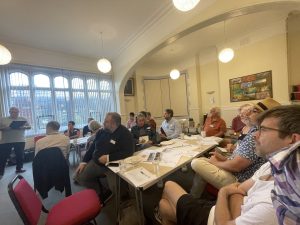 For our 1st workshop we held on 26 Aug 2025 we had 20 participants, local businesses and private residents in similar numbers, 2 guests from InExeter (whose CEO Nicola Wheeler is helping with reaching out to the local business community) and 2 local councillors. After an introduction by Keith Lewis (Chair of Exeter Civic Society) and Gert Vonhoff (project lead) we had a good discussion at two tables to be followed by bringing the results together and participants filling in feedback questionnaires. All the contributions have been drawn together in a summary, under: https://exetercivicsociety.org.uk/wp-content/uploads/2025/09/North-Street-Workshop-feedback-Tables-1-and-2-and-feedback-forms.pdf , which also includes the ideas for an alternative suggestion for traffic flows in the whole area, which we started discussing at one table and which then was taken one step further by Chris Pope, one of our new members.
Amongst the participants of the workshop there was agreement that a lot is negative about the current state of North Street: layout and lighting makes it feel grim, unsafe and under-loved; a nicer route from High Street to City Gate area and Ironbridge would raise the profile of the area and connect it better to some of its heritage sites; a reduction of traffic and incentives for pedestrians would be important to stabilise businesses in the street and produce a better thoroughfare to areas north of North Street.
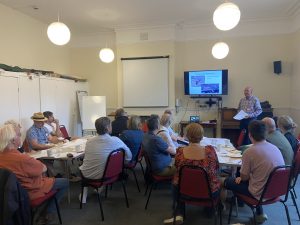 It was stressed again and again that the key would be to re-establish and promote the identity of place for North Street. The alleyways could play a central role on more than one respect. A conversion of the one-way traffic might offer solutions. Road layout, pavements, pedestrian and cycle use need to be brought into an integrated solution. There needs to be a review of the loading bays and parking in the street. Lighting, public and commercial bins need to be improved. A possible greening of the street was discussed. All these steps should help to support the businesses and improve the living conditions of the residents and experience of the visitors.
Next steps will be:
- Widen participation by making the material available on our website and through contacts in the area.
- Working with Fabrica Architecture to possibly develop their original study further.
- Coming up with some precise suggestions for North Street and the area.
- Calling another meeting to discuss these suggestions, with more local councillors and possibly ECC and DCC officers attending.