
What we are about
A small working group, led by David Solman who replaced Stephen Mariner and Ruth McLeish in this role in Nov 2024. The taskforce will look into how to improve tree preservation in Exeter.
It is good to see efforts being made to further develop and improve the Valley Parks in Exeter under the stewardship of Devon Wildlife Trust, but too often we have just seen and still see mature trees vanish in our city scape. The ‘Tree Preservation Taskforce’ wants to look into how best to prevent this from happening by establishing a network of contacts in the city and raising its voice where trees are under threat.
Exeter City Council’s Tree Preservation website has been without lists or maps of TPOs since summer 2022. We want to see these data updated and made available to the public again.
We want to explore whether there are alternatives to felling diseased trees and those regarded as unsafe in insurance terms in public places. Tree surgery can re-juvenile trees and make them safe(r) again. As the Chestnut tree east of the Cathedral illustrates even boarding the space underneath a tree off by a rope line can help making spaces underneath old trees safer and enabling them at the same time to preserve their root system. Diseased trees also provide living spaces for different segments of wildlife, which might be taken into consideration before just felling them prematurely.
Hedges and shrubby areas are important features in our natural landscape and can offer wildlife resorts even in the most densely populated city centres. They need maintenance and care to fulfil their important functions. We need to learn to look after them in better ways.
Improving the protection of trees in the City (Autumn 2025)
The ECC TPO map now accessible again looks incoherent and is missing vital data, which once have been available online. In order to improve the tree protection in the city, advice from the Sidmouth Arboretum has triggered two projects to raise awareness, get the (local) public behind our initiative and this way convince the politicians and officers to spend some more energy and (rare) money on improving a tool which will help monitoring the city trees.
We will start with two tangible projects: 1) Bull Meadow Park as an area for TPOs (start in Sep) and 2) Prospect Park as an area for street trees (with only 1 TPO, work to start in October).
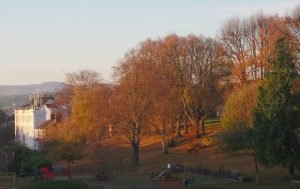
Bull Meadow Park
We dedicated our Autumn Tree Walk on 10 September 2025 to the start of the work in Bull Meadow Park: Expert and tree enthusiast Ed Dolphin from Sidmouth Arboretum Trust provided us with a online tree map for the park. Together with David Solman he identified and photographed the trees and created the Google Maps online ‘Tree Map for Bull Meadow Park’.
The real surprise on the walk was the unveiling of this map, as we had thought this could not have been finished during the summer. The link to the Tree Map is: https://www.google.com/maps/d/u/0/viewer?ll=50.7192851358766%2C-3.526322750000004&z=18&mid=1HqiMiIGVezYEDn0CNRKeOeK7MjiuVGU The map is still under construction, for example we want to add a short history of the site (red info icon, currently linked to Exeter Memories site). We also want to add concerns we have about the state of individual trees and whether action is needed. This way the Tree Map will become more than just an identifying tool: it generates general interest in tree preservation, gives local residents an idea of how better to look after our city trees and all of this will help to encourage and support Exeter City Council’s work on the parks and their trees.
 There is also a QR code for the map, which will be displayed on the information board at the lower end of the park near the playground.
 The Dean and Chapter of Exeter Cathedral has worked with the Sidmouth Arboretum Trust on a similar map for the ‘Trees of Cathedral Green”. The link to this map is: https://www.google.com/maps/d/u/0/viewer?mid=1QtQUSvMVaJLWXMg-PfFn93YEqn7m0lI&ll=50.7224321%2C-3.5309671999999948&z=18
The QR code for the Trees of Cathedral Green can be found next to this text.
Ed Dolphin also teamed up with the university and two such codes will be placed in their grounds, so our effort can be ‘sold’ to ECC as part of a bigger initiative from which the city will benefit.) We are meeting up with him in early October to create more Exeter Tree maps. If you are interested please contact us.
Prospect Park (Road in Pennsylvania)
For October the taskforce will run a door-to-door enquiry about the residents’ willingness to engage with protecting their street trees and mapping issues. Only one of the mature trees has a TPO, some have been felled in recent years endangering the street to lose its leafy character and identity. Potential next steps after that: Approaching DCC to grant all trees in this street TPOs, plan a local event with residents (they have been known for their street parties bringing the community of permanent residents and HMOs/students together), finding out whether we can include the university outreach team as well in this.
Both projects can function as blue-prints for similar projects all over the city: a good follow-up might be Priory Park, where a local neighbourhood association looks after the park, plants trees, but after last winter storms a few of the mature trees had to be cut back substantially of vanished completely.
Local volunteers are very welcome to join our taskforce. Contacts please by email to David Solman ( abneylinks@mac.com ).
Lucombe Oak bought by David Solman for the ECS (Spring 2025)
After our March meeting, David Solman (Lead Tree Preservation Taskforce), was able to buy a Lucombe Oak for the Civic Society. He presented the very young tree at the ‘Spring Social’ of the society on 12 April. David will foster the tree for another two years, ECS in the meantime will deliberate where best to plant this tree.
For more inform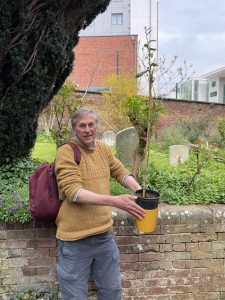 ation about Lucombe Oaks, see: https://www.exetertrees.uk/lucombe-oak.html
Terrence Pickles describes the origin of this Oak species on his website ‘Exeter Trees’: ‘The Lucombe oak is a very special type of oak in so many ways. It is a semi-evergreen which in itself is unusual as most trees are either deciduous or evergreen. The reason it is semi-evergreen is because it’s parent trees are two very different types of oak. The Turkey oak is deciduous and the Cork oak is evergreen. This was discovered by William Lucombe who was a horticulturalist and nurseryman of Exeter. His love and study of oak trees led him to discover these natural hybrids and they were named Lucombe oak. They are also sometimes know as the Exeter oak.’
Larkbeare House - Trees in Grounds
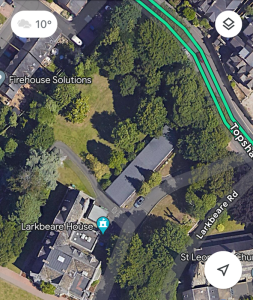
News Update: National recognition for the Grounds of Larkbeare House. In August 2024 the Secretary of State for Culture, Media and Sport, included the grounds of Larkbeare House on Historic England’s national Register of Parks and Gardens of Special Historic Interest at Grade II. Read more under: https://exetercivicsociety.org.uk/national-recognition-for-the-grounds-of-larkbeare-house/
The 5.4 acres of grounds around Larkbeare House, in St Leonard’s between Topsham Road and the River Exe, contain one of the finest collection of mature trees in the City Centre. With Devon County Council selling House and Grounds, Exeter Civic Society is increasingly concerned this impressive feature of the cityscape (especially when seen from the river side) could vanish for ever. Currently the trees are only protected by being part of a conservation area. Our Tree Taskforce went out on 19 Feb 2024 to start identifying and listing the trees, as this seems not to have been done before. Hilary, Angela, Stephen and Gert were helped by David Solman and Ed Dolphin (Devon Gardens Trust) with their skills in identifying species. The website linked here will provide our initial findings and more details on the house and grounds. We will return to the side to investigate the site further.
As a result of our findings, Exeter Civic Society asks
- Exeter City Council to put Tree Preservation Orders on the trees; we are in contact with Joe Morshead as ECC Tree Manager;
- present and future owners to keep the Grounds of Larkbeare House not only in their present biodiversity, but also to guarantee appropriate management;
- Devon County Council as current owner of the site together with Exeter City Council to try to safeguard public access to the grounds or at least part of them; the grounds have potential in the rising interest in eco-tourism, especially as they are so close to the Quay as the city’s second most visited tourist attraction;
- that Larkbeare House will be at least locally listed; we are in contact with Dianne Long from Devon Gardens Trust and with their conservation officer Jonathan Lovie for looking into a listing.
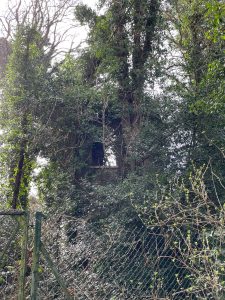
‘Money was not spared on the garden, with Veitch’s nursery contracted to landscape it with a full range of shrubs and trees’, as Exeter Memories says. From the wide range of outbuildings, the ruins of what was called the Summer House can still be seen in the lower part of the garden (fenced in). Sometimes referred to as the Belvedere Tower, it looks more like a folly than a summer house.
Mature tree on corner Southernhay East / Barnfield Road (early 2023)
A mature tree was felled earlier in 2023 and replaced by a very small new one in this location. As far as we know there was no notice posted in Southernhay to alert to this action happening. [photos to be provided]
Trees and shrubbery on Bonhay Road (Sep 2023)
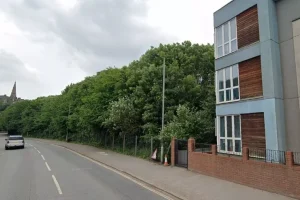 A not built upon stretch of land on Bonhay Road is currently for sale. It is is approximately 0.56 acres in size and currently occupied by trees. It runs parallel to the railway line, less than a quarter of a mile from Exeter St David’s station. The other side of Bonhay Road is largely made up of terraced houses. The trees could be chopped down as the plot is advertised as an opportunity to build student or co-living flats, a healthcare facility or other residential properties. We ask whether this rare bit of natural habitat on the eastern side of the river could be saved by being purchased by Exeter City. Update May 2025: no further information available.
Hedgerows in Pinhoe
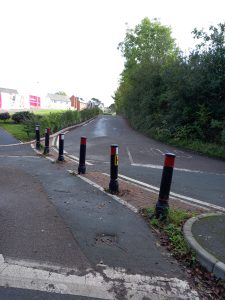
Gypsy Hill Lane where left hand hedge has been replaced by saplings and the Lane widened to take greater volume of traffic to the new houses.
Linden homes began an extensive building programme on the outskirts of Pinhoe just over the main railway line to Waterloo around 3-4 years ago. Every field bordering on the line has now been covered in houses right up to Motorway (M5) and beyond into East Devon. This has seen some of the old trees being saved, sometimes having fencing around them to protect from the builders (we assume), but hedgerows seem to be fair game.
We have watched in horror as these are torn down, for instance on Gypsy Hill Lane a once quiet little lane that only led to the Hotel at the end and a pedestrian/cycle bridge over the motorway. The left-hand side of this lane is now devoid of hedges and this has been replaced by a planting of some young saplings, which no doubt will in time provide cover for the houses behind. However, the loss of habitat for the wildlife is immense, not only birds and mammals but also insects which are slowly being eradicated.
Another example is Pinn Lane which leads to the old A30 (Honiton Road) where again hedgerows are disappearing for no apparent reason, perhaps in readiness for the next phase of development. On one stretch this is now replaced by wire fencing which is an eyesore and in places quite precarious.
The builder is now on phase three and so we have yet more destruction to come.
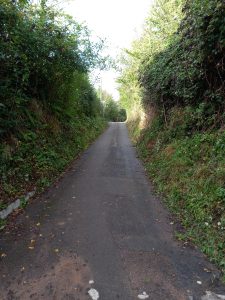
Harts Lane which has been left intact
The irony of it is that they then allocate an area of land to one side of their development and call it a “wild life area” which consists of the balancing ponds necessary to drain the area where a natural stream once ran which has been piped underground and fed to this area.
We now hear there are plans afoot to build a further 150 homes on land that was once a dairy farm – MossHayne farm. So no doubt more hedges and landscape will disappear in the pursuit of new housing. Could we find a way to co-exist with our existing green spaces, as these would provide both physical and mental balance to our very pressured and stressed lives?
4 Norway Maples on Denmark Road adjacent to the old Pyramids Swimming Pool (May 2023)
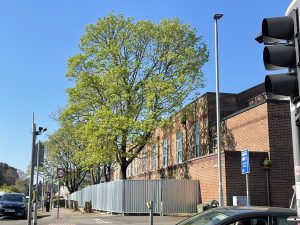 In early May ECS asked ECC Tree Manager Joe Morshead whether these four Norway Maples which were newly fenced in to mark the future building site had TPOs. We received a reply on 12 May that he had made a recommendation for the four trees to be included within a new TPO. We still have to find out whether the TPO was actually implemented. Update May 2025: the newest online listing shows these trees are TPOed now.