
Test layout of Tree Details for Heavitree Pleasure Ground
Updated 03 Nov 2026
Folder Material & Paper Map
The twin pages which will be displayed in a folder.
The paper poster map.
An interactive map of all the trees identified.
The Exeter Civic Society’s Tree Preservation Taskforce
Test layout of Tree Details for Heavitree Pleasure Ground
Index
- 01: Black Mulberry
- 02: Magnolia Grandiflora “Exmouth”
- 03: London Plane
- 04: Sequoia
- 05: Dendrochronology
- 06: Red Horse Chestnut
- 07: Coronation Oak
- 08: Black Walnut
- 09: English Walnut
- 10: Silver Leaved Lime
- 11: Honey Locust
- 12: Hungarian Oak
- 13: Red Norway Maple
- 14: Red Oak
- 15: Tree of Heaven
- 16: Tulip Tree
- 17: Pendant Lime
- 18: Manna Ash (grafted)
- 19: Sweet Chestnut
- 20: Dawn Redwood
- 21: Oak
- 22: Paperbark Maple
- 23: Black Locust
- 24: Horse Chestnut
- Ordnance Survey Map 1887
- Ordnance Survey Map 1937
- Introduction
01 Black Mulberry
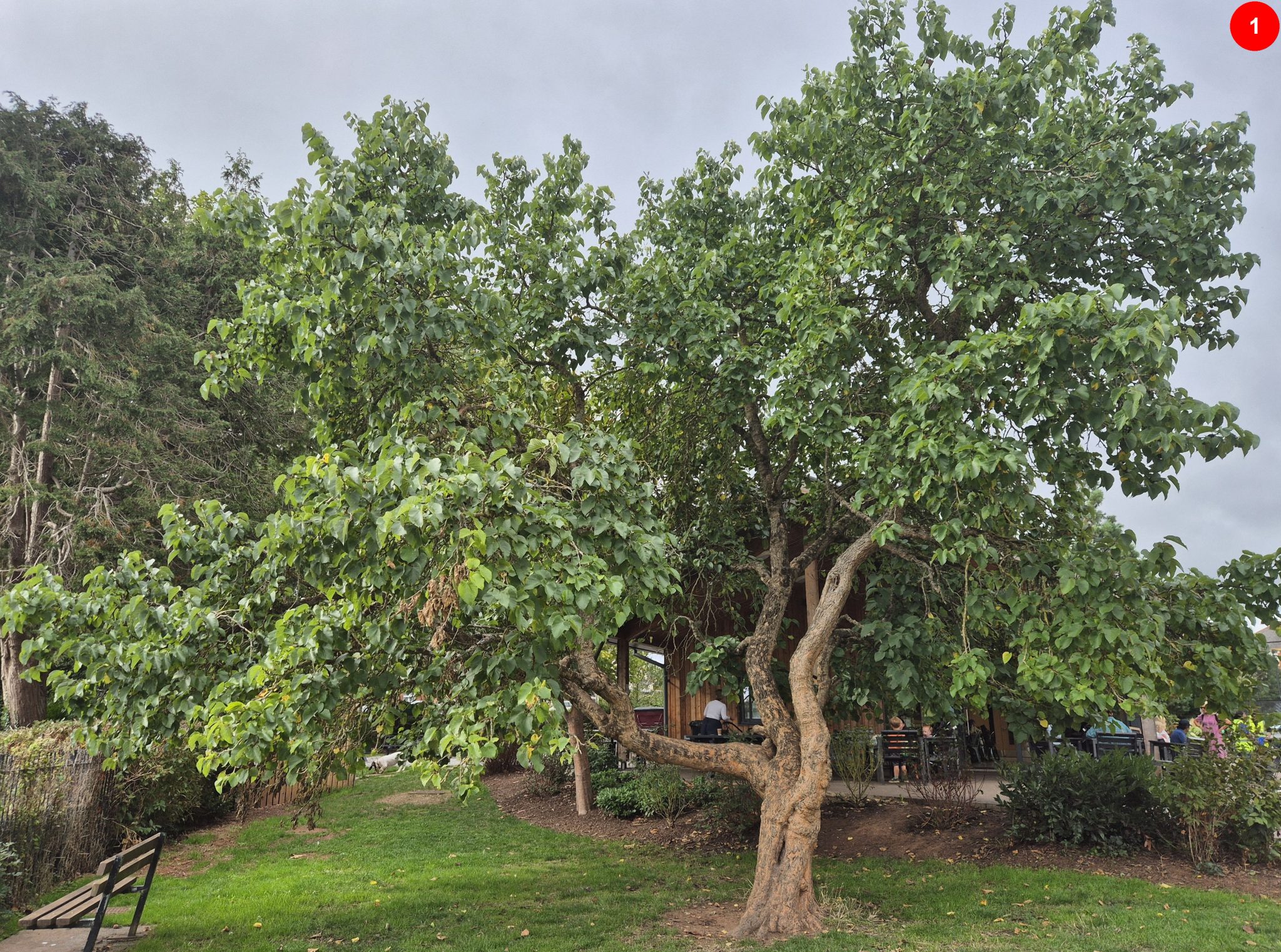
With an abundance of edible fruit and an interesting, twisted trunk it dates back to the 1500s when it was brought from SW Asia.
King James the First mistakenly ordered thousands of these trees to be planted in the 17th century to establish a silk industry in this country to rival that of China, not realising it was the leaves of the white mulberry tree which were preferred by silkworms, not black.
02 Magnolia Grandiflora “Exmouth”
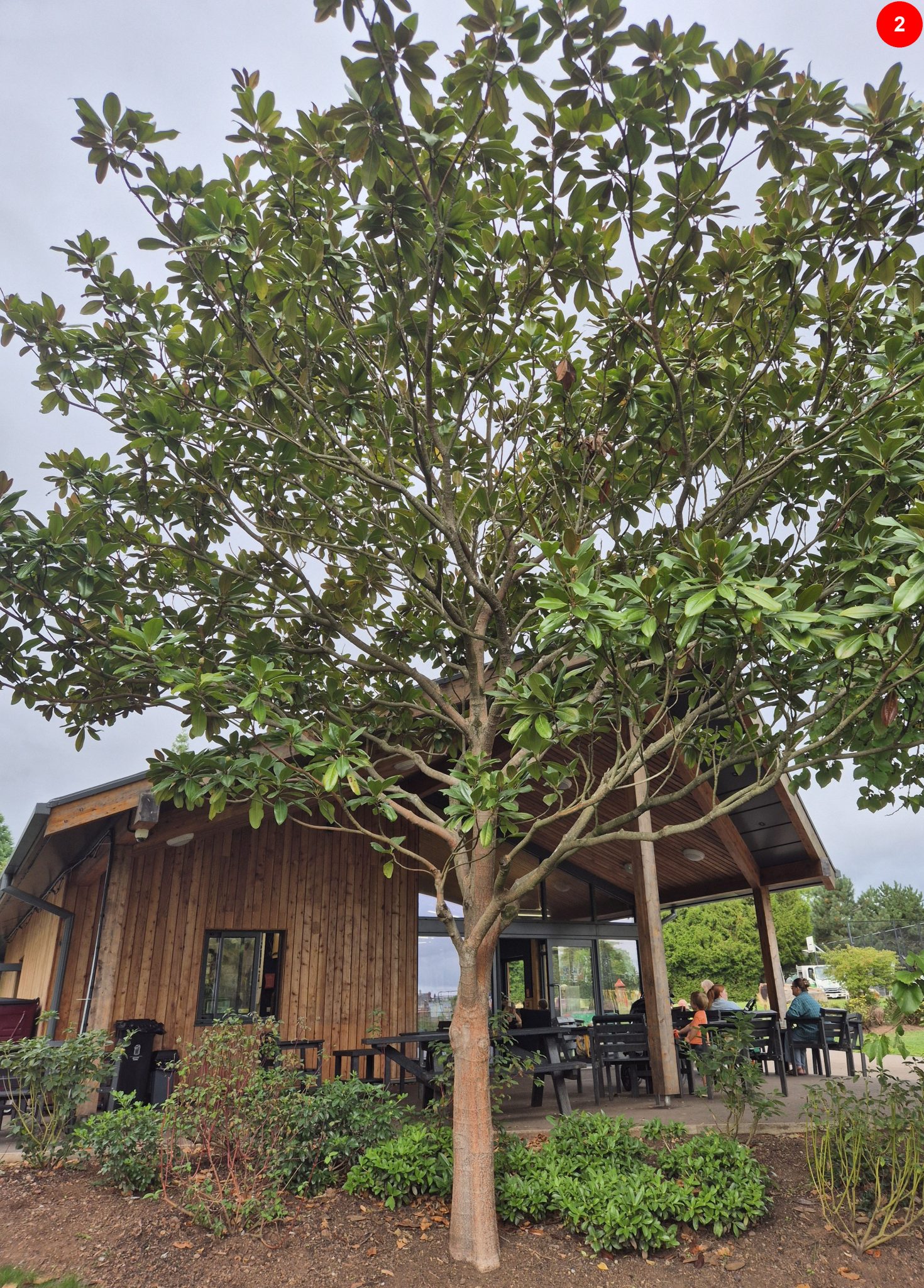
It’s thought that the first Magnolia Grandiflora was brought over from S. Carolina by Sir John Colliton in the early 1800s. He planted it in his garden bordering Exeter Road in Exmouth, hence the name.
It’s a hardy evergreen tree with glossy green leaves on the topside, brown and fuzzy on the underside. Its flowers are fragrant, creamy in colour and pollinated by beetles. In larger trees they can reach 9″ across.
03 London Plane
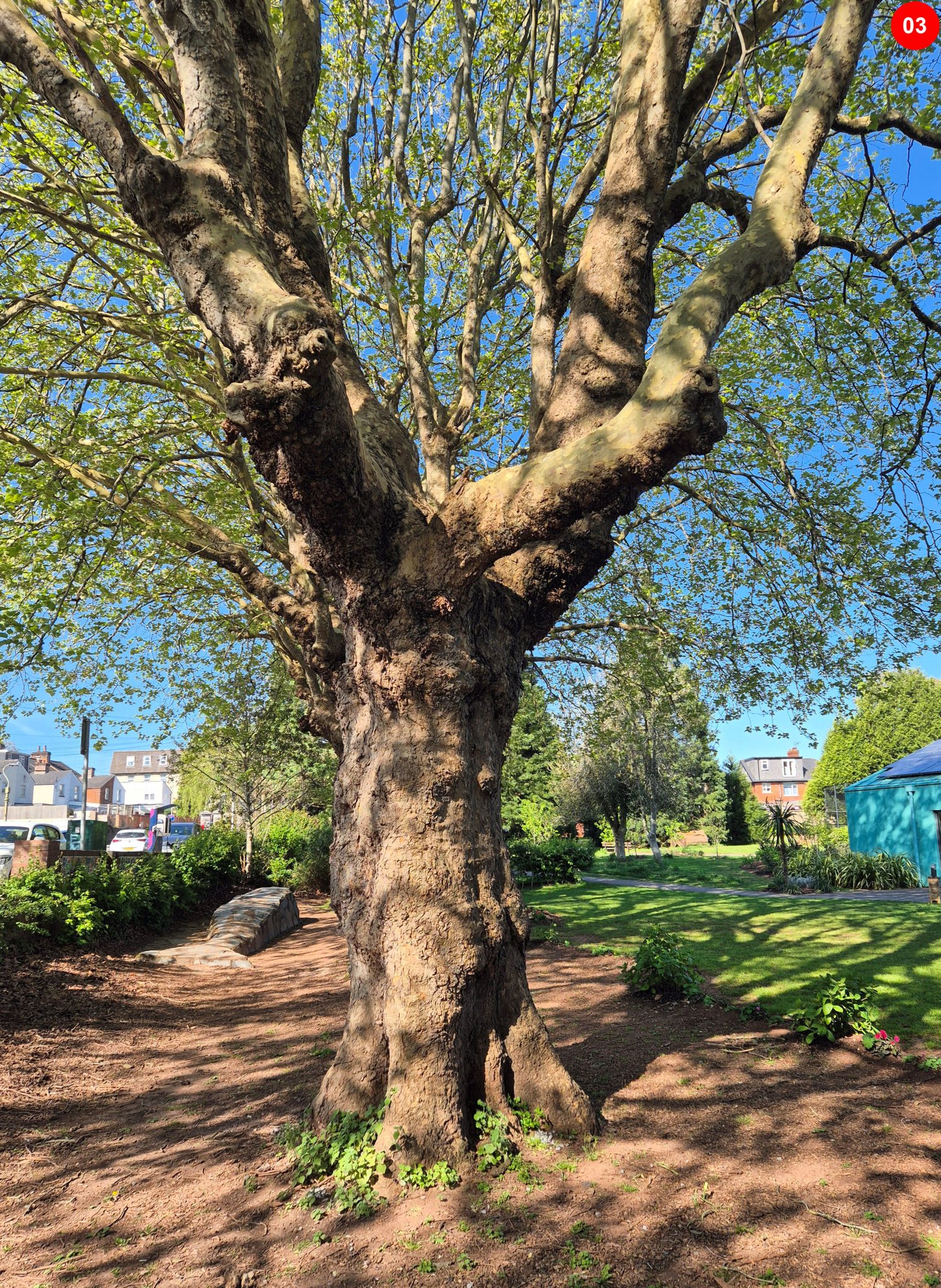
In the 17th century in a botanical garden in Lambeth, an American sycamore and an oriental plane tree were hybridised resulting in what we now know as the London Plane. By the 1920s, 60% of the trees lining London’s streets were London Plane, particularly the leafy squares in the affluent parts of the city. It was heavily planted in Victorian times as it was found to cope well with the smogs and soot generated by the Industrial Revolution, as well as soil compaction beneath pavements. The soot is trapped in the bark and shed to reveal an unmistakable “camouflage” bark with olive green and grey patches in younger trees. The 4 here are older and the bark has become deeply fissured. Growing up to 40m in height and a spread of up to 30m it gives a lot of shade, also making it popular as an urban street tree.
It is long lived and has large maple-shaped leaves. The flowers are pollinated by wind resulting in large spherical fruits that stay attached to the tree over winter.
Many cases of hay fever in spring are attributed to the London Plane. Not only the pollen, but also fine spiky leaf hairs and seed fibres are shed into the wind causing mechanical iritation.
04 Sequoia
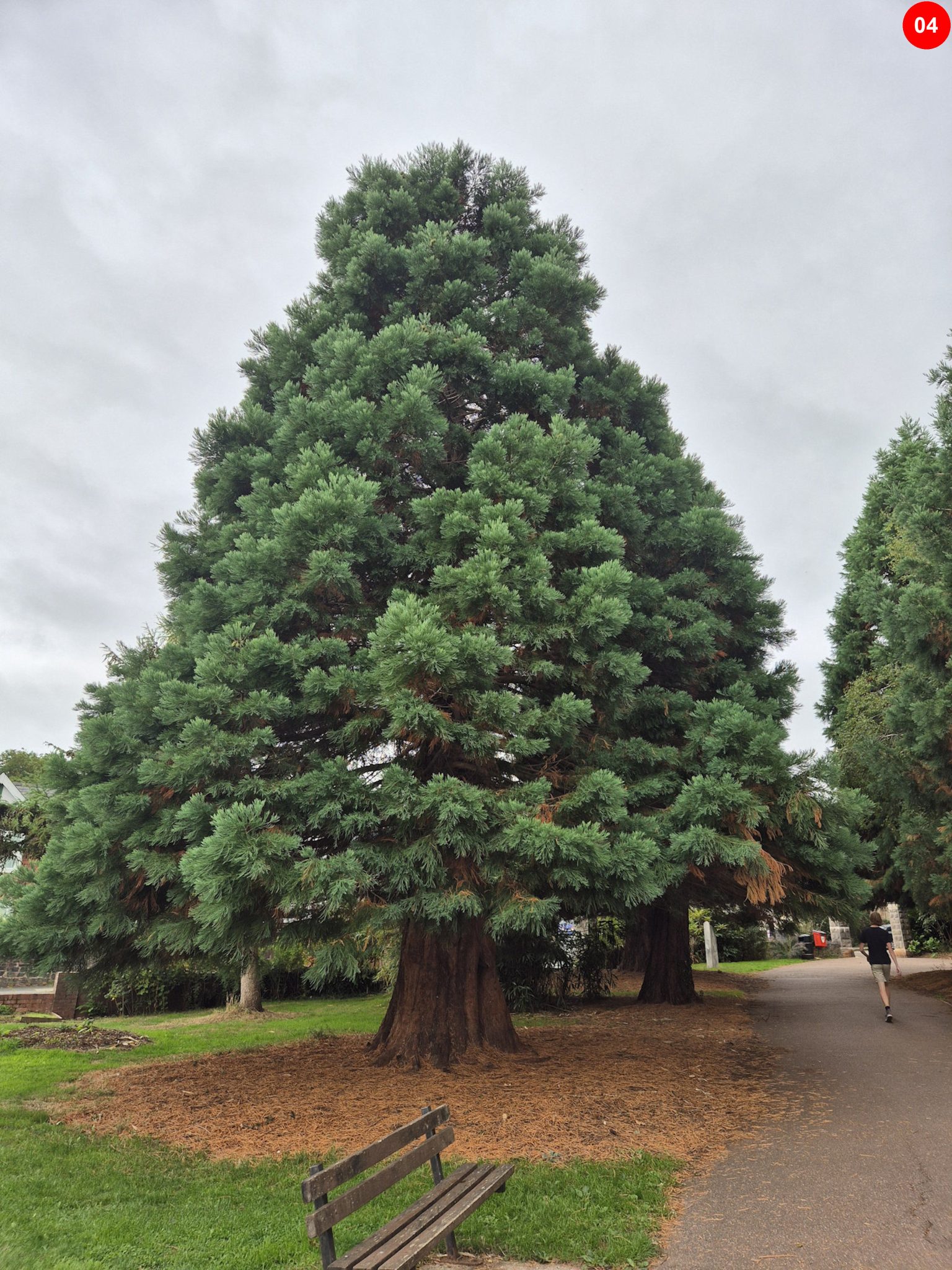
Giant Sequoias are coniferous and the most massive trees in the world. They were introduced into Britain in 1853 from California. It’s thought that these native trees could be 3500 years old and grow to nearly 100M high. They are also called Wellingtonia, named by an Englishman, Sir John Lindley in honour of the recently deceased Duke of Wellington This sparked American indignation as they wanted to name it Washingtonia after George Washington.
It is related to the Dawn Redwood which we also have in the park.
They have very dense foliage, a flaring red trunk and a spongy bark growing to 300mm thick, which provides a degree of protection from forest fires.
The needles are actually scale-like leaves, bluey-green in colour, while the flowers, both male and female, appear as cone buds in October. The following year pollen is released from the male flowers in March, and seeds reach maturity at the end of the 2nd year. These go on to be released from the dry cone in 3 ways – a wood-boring beetle, squirrels, or in their native environment by fire.
05 Dendrochronology
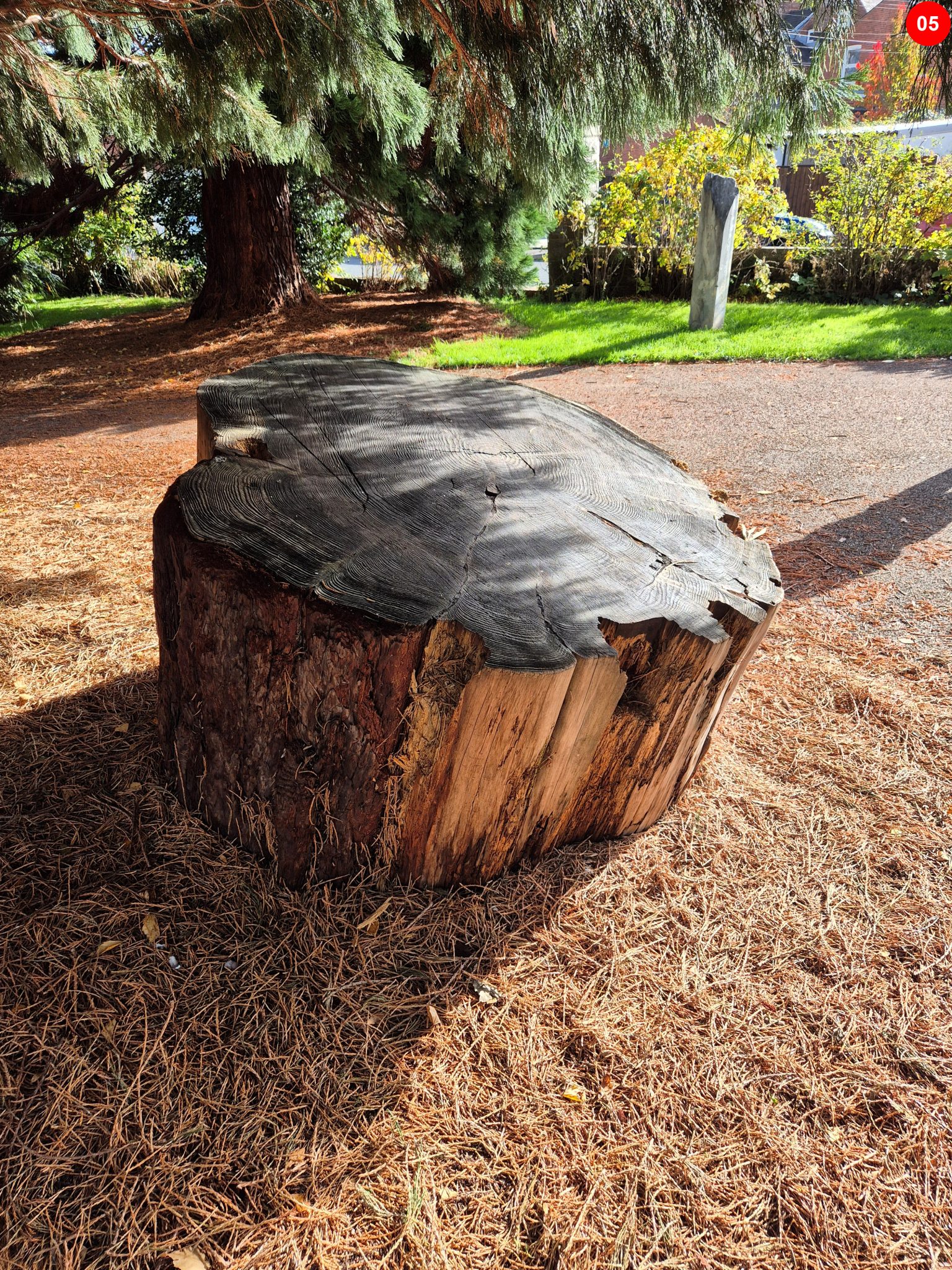
This is the study used to date the age of trees by counting the number of rings on a felled slice, as trees add a growth layer every year. 135 were counted on this sequoia meaning it was 135 years old when it was cut down and planted therefore around 1889.
This was puzzling as the Pleasure Grounds weren’t opened until 1905 and old maps don’t show any trees here before that date. A resident solved the mystery by reporting that the tree grew alongside Wonford Hill, and slices were moved here after felling.
06 Red Horse Chestnut
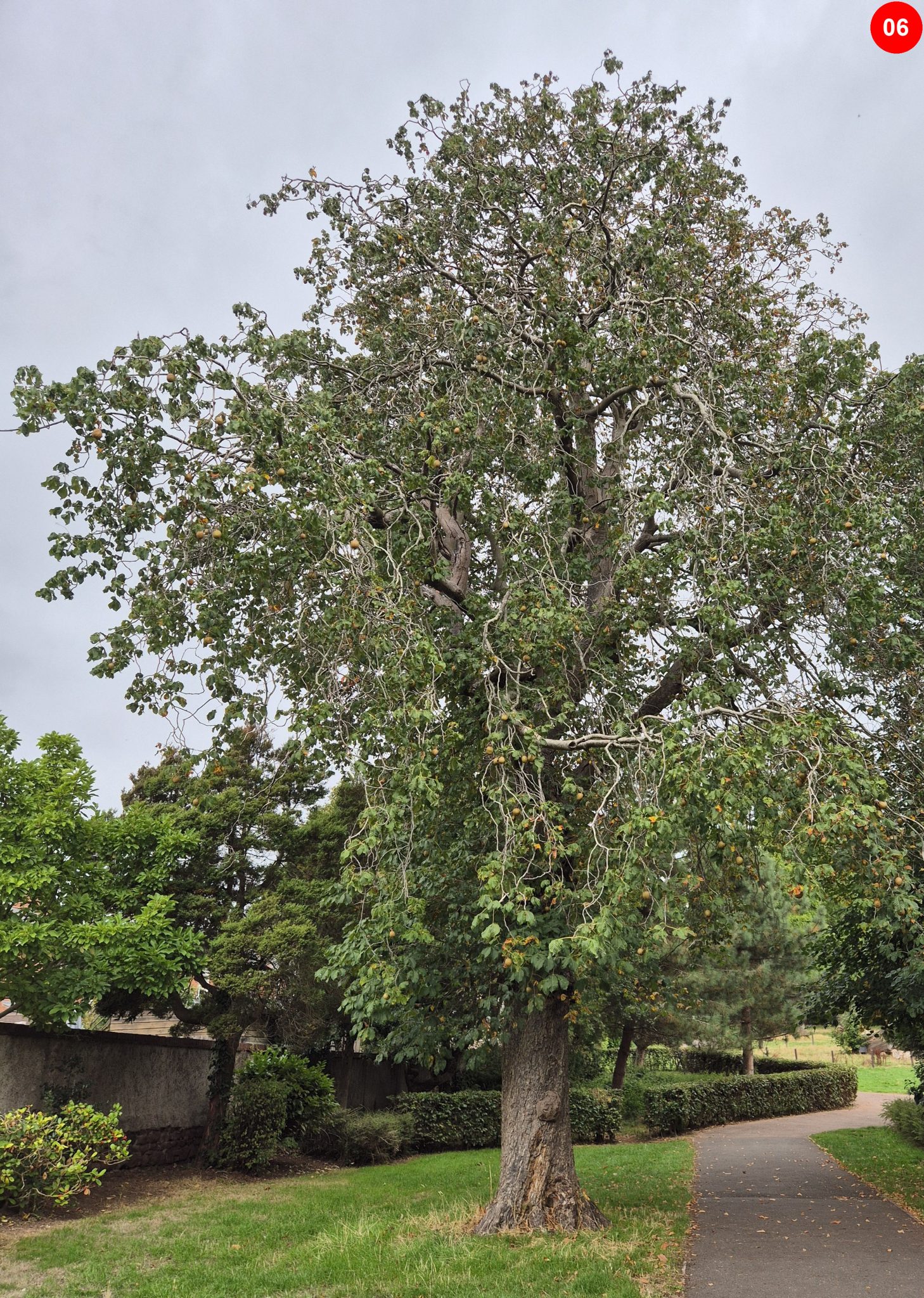
So called as its attractive flowers appearing in late spring are a pink / red colour formed in cone-shaped clusters. The tree itself differs from the normal horse chestnut as it is smaller and produces smaller “conkers” with fewer and shorter spines. It is not related to the sweet chestnut and its fruits are not edible.
It is a relative newcomer to our parks and gardens, only appearing in this country in the 1800s when it was brought over from Germany.
07 Coronation Oak
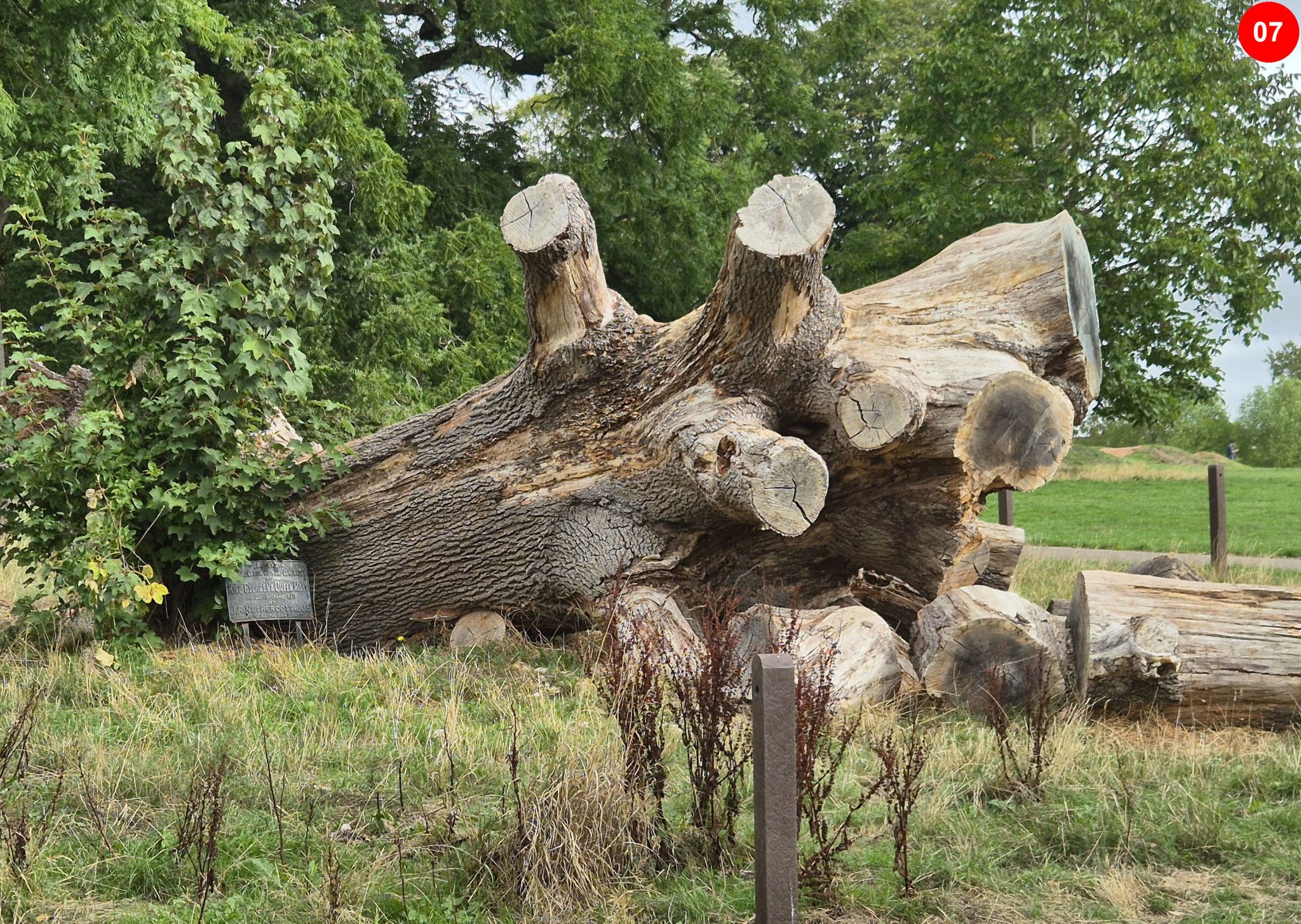
A plaque alongside the oak reads “Planted in Commemoration of the Coronation of King George V & Queen Mary on 22nd June 1911 by J. R. Nethercott esq J. P., Chairman of the Heavitree Urban District Council”.
In July 2009 it split in two on a stormy morning. The tree “cracked down the middle”. A Council spokesman said that the crown of the tree will be reduced and that it would survive for another 98 years. The adjacent 2016 photo above shows that many of the larger limbs were trimmed. The tree was pulled down in 2023 (confirmation needed), and has been retained as a wildlife habitat.
08 Black Walnut
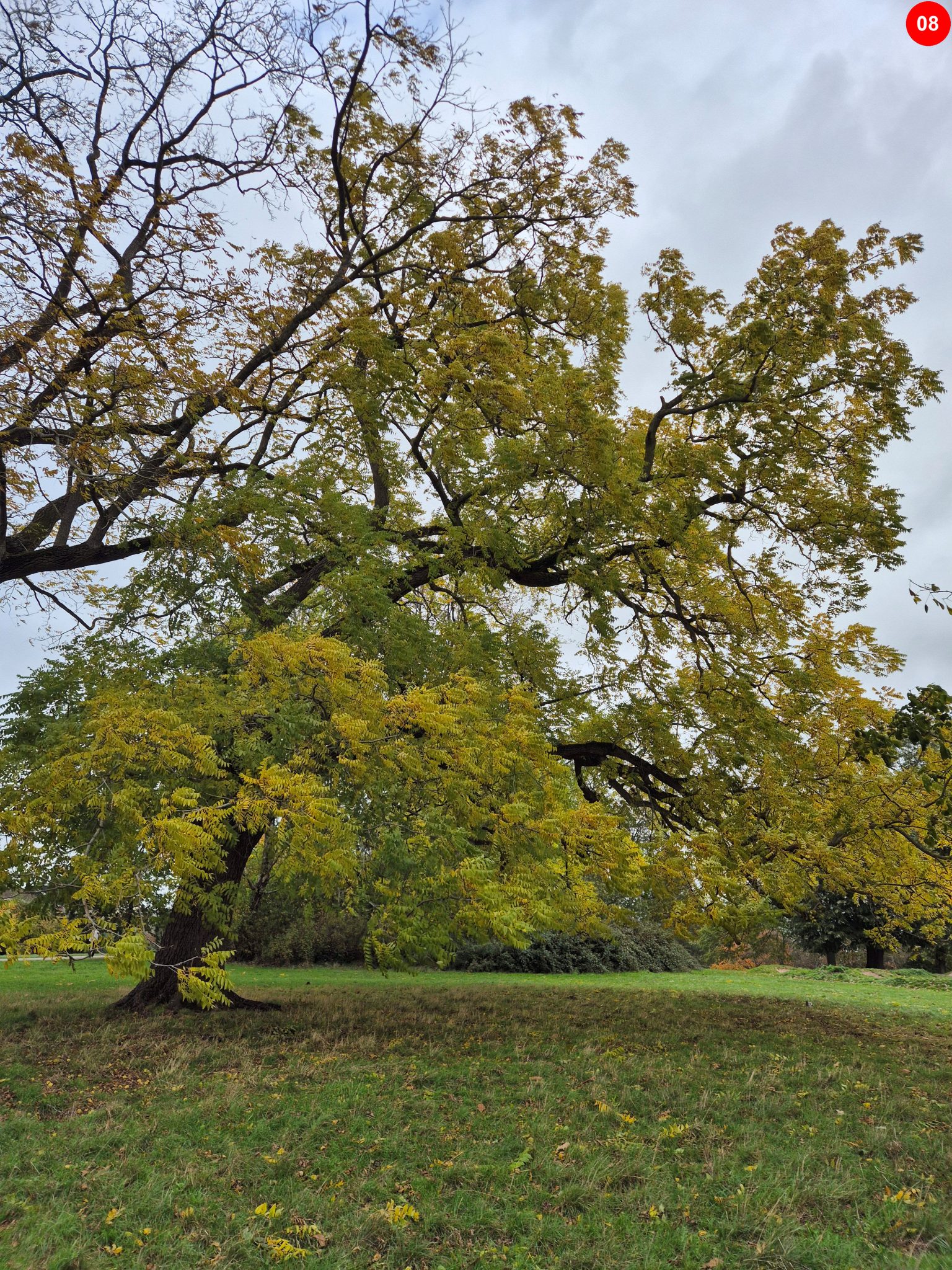
These huge trees, originating from North America, grow up to 40 metres high.
Their nuts, although edible, are so hard they are used in sand blasting to clean ships and jet engines but also commercially for extracts for the catering industry. The wood goes for furniture, flooring and coffins.
The roots and leaves produce a natural chemical called juglone which discourages the nearby growth of other plants.
09 English Walnut
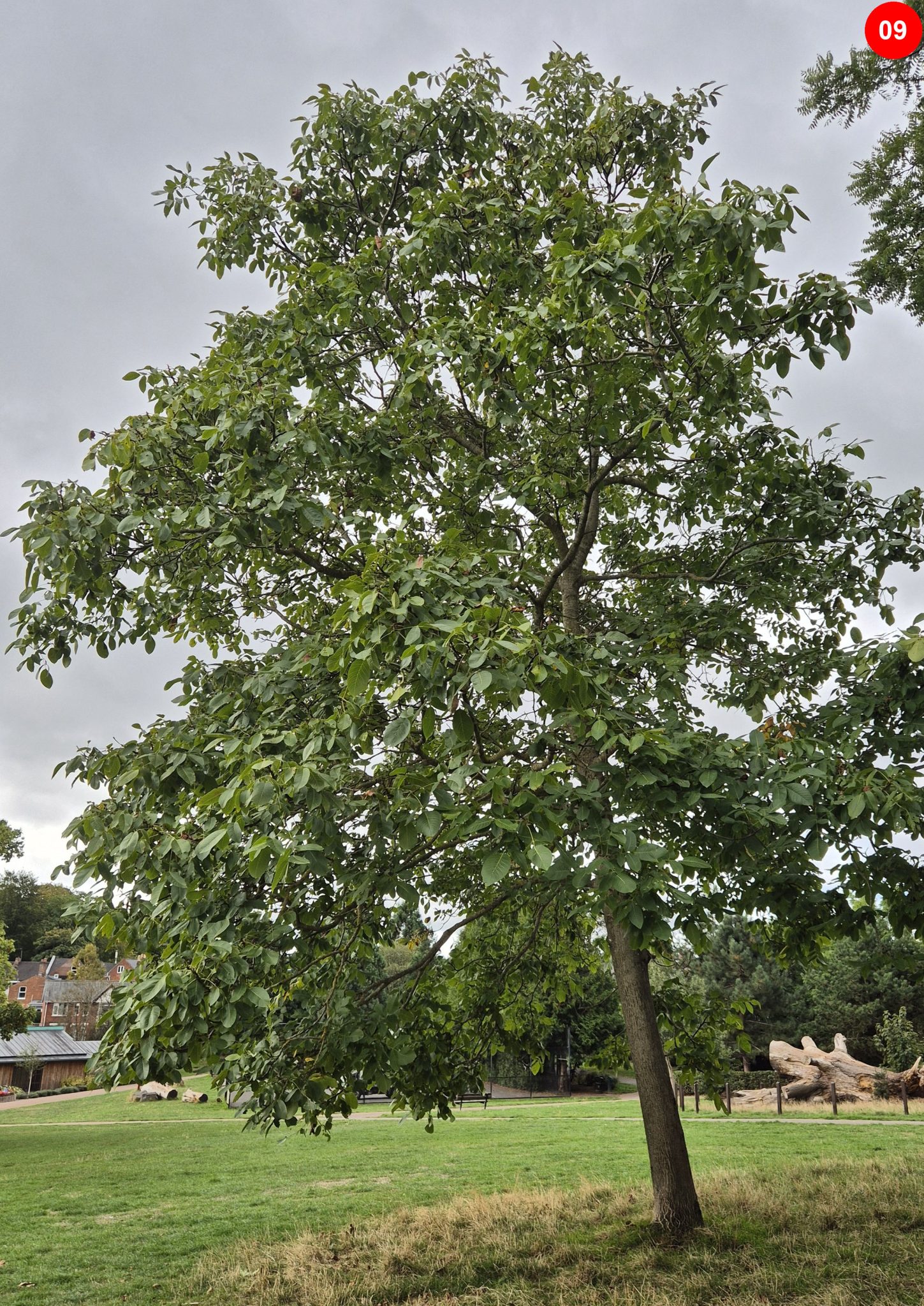
Native to Iran, but it has been grown in Britain since Roman times. Legend has it that it was planted in the Hanging Gardens of Babylon. The edible nuts are easily removed from the hard shell, unlike those of the black walnut, and have a sweeter taste and have been used in cookery for over 2000 years.
The wood is lighter in colour compared to the black walnut, and consequently used for more everyday furniture and decorative turnings.
10 Silver Leaved Lime
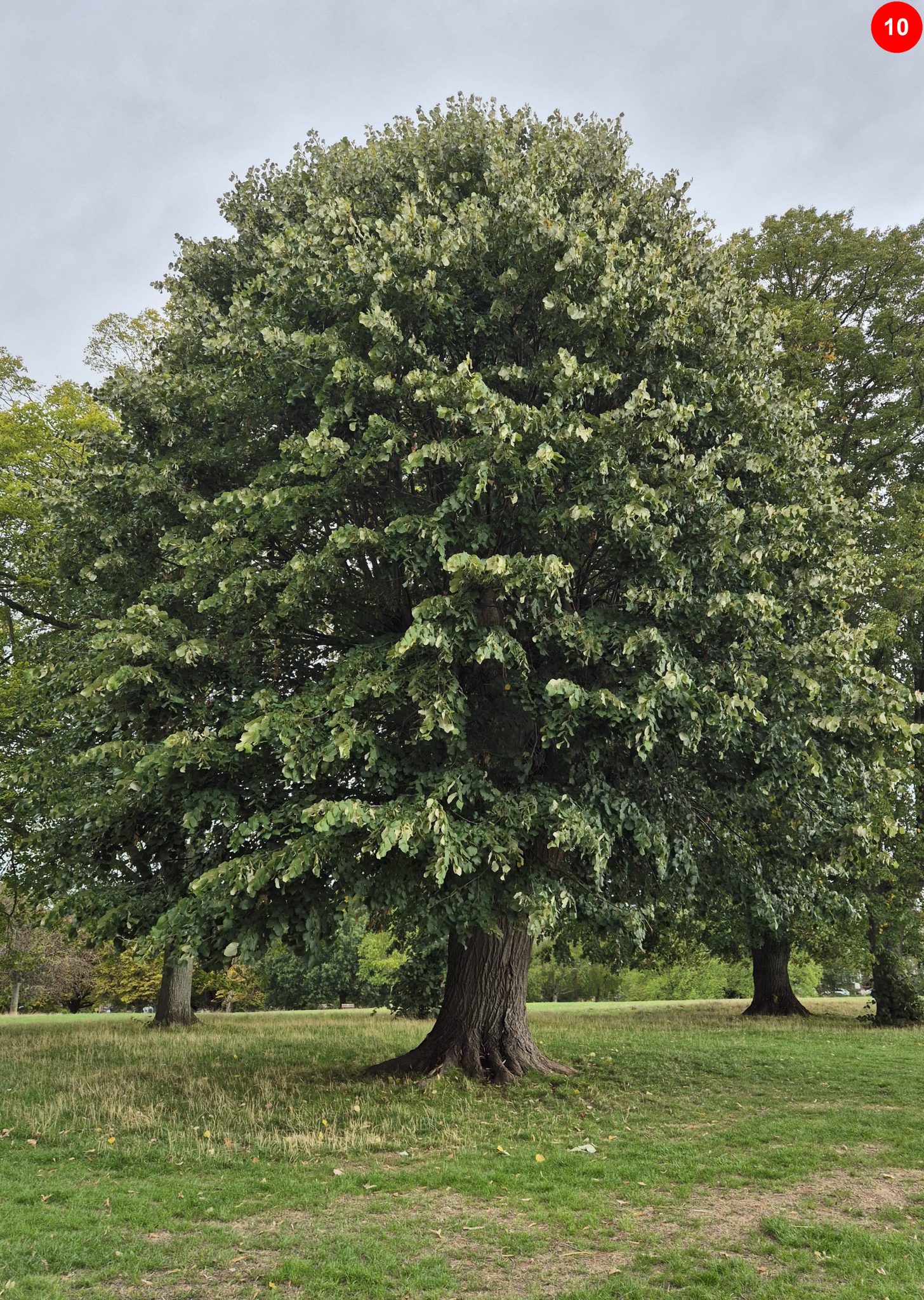
Although named Lime they have no connection to the small green fruit found in food shops and come from a completely different plant family.
The undersides of the leaves are a silvery white, seen best in windy conditions, giving a shimmery effect.
They have small fragrant, creamy flowers loved by bees for the nectar. The sticky honeydew that drops from most lime trees is actually the secretion from aphids feeding on the nectar, not from the tree, but the silver leaved variety is not so attractive to aphids because of the hairy underside of the leaves.
Their longevity and toleration to pollution has led to them being widely planted in parks and as street trees.
11 Honey Locust
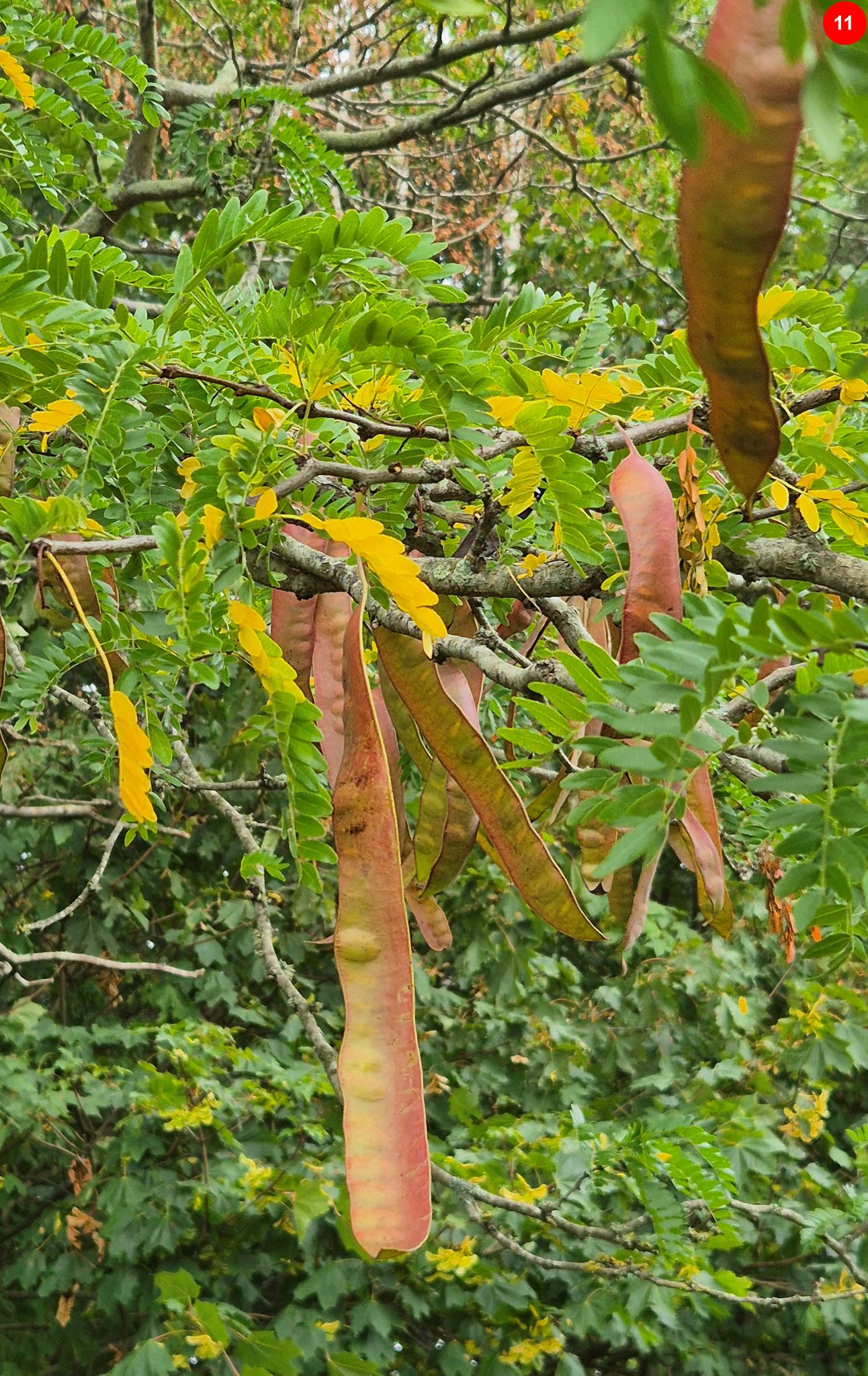
The honey locust tree is a member of the pea family originating in North America. It’s notable for its large (up to 35 cm long) yellow pods which contain a sweet gooey pulp surrounding large oval seeds, which is a favourite food for wildlife. The wood is prized by woodworkers for its varied coloured wood although the trunk and branches are covered in fierce thorns, giving it its alternative name of thorny locust.
12 Hungarian Oak
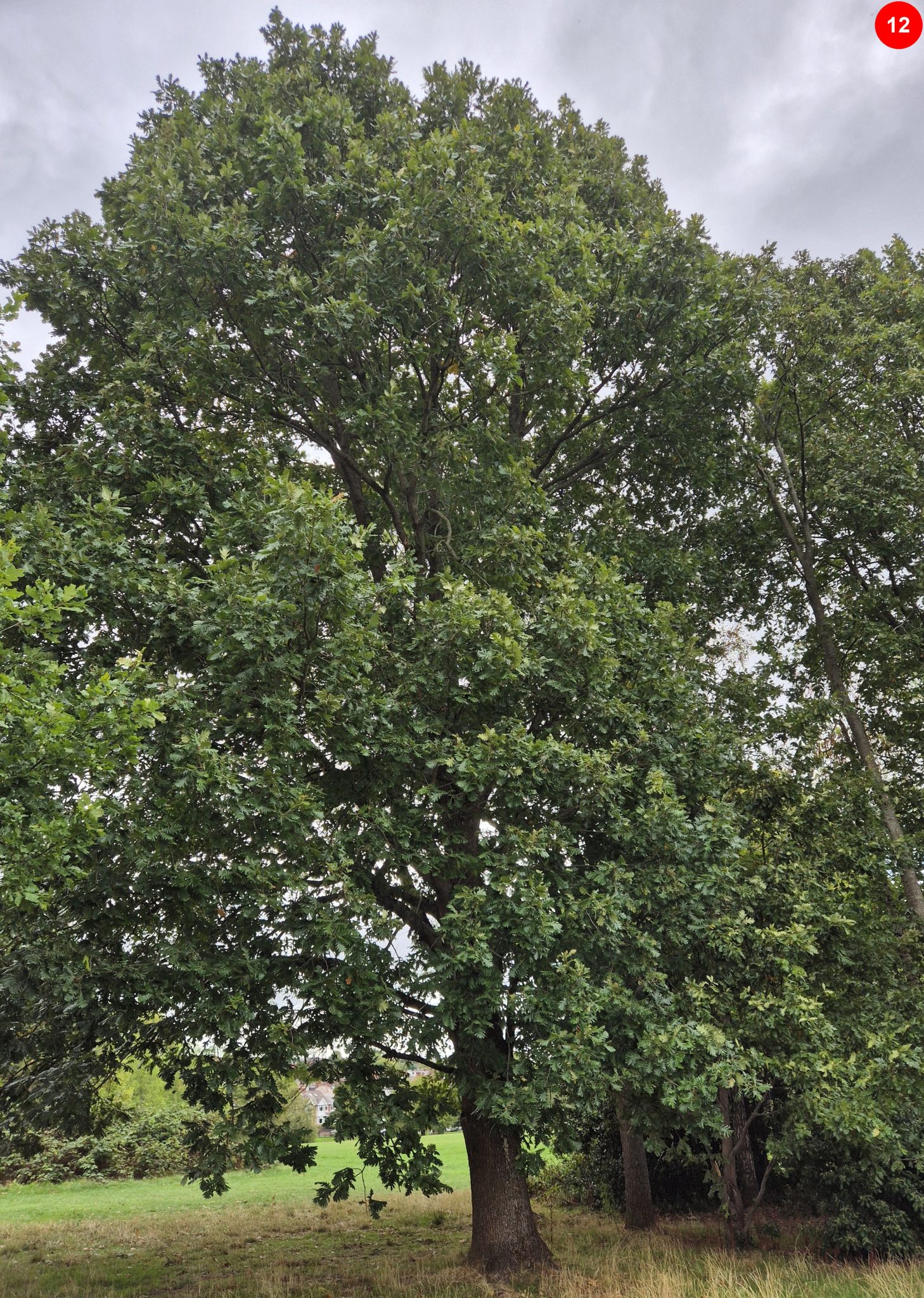
Growing to an impressive size and age, these oaks, originating in E. Europe are often planted to enhance biodiversity in forest regeneration.
The leaves are large, glossy and deeply lobed, turning a vibrant russet colour in autumn. The acorns are particularly large with distinctive cups covering half of the acorn.
The rich golden-brown wood with a dense grain is used for quality furniture and woodcraft, also for wine barrels where it gives flavours and aromas to the wine.
13 Red Norway Maple
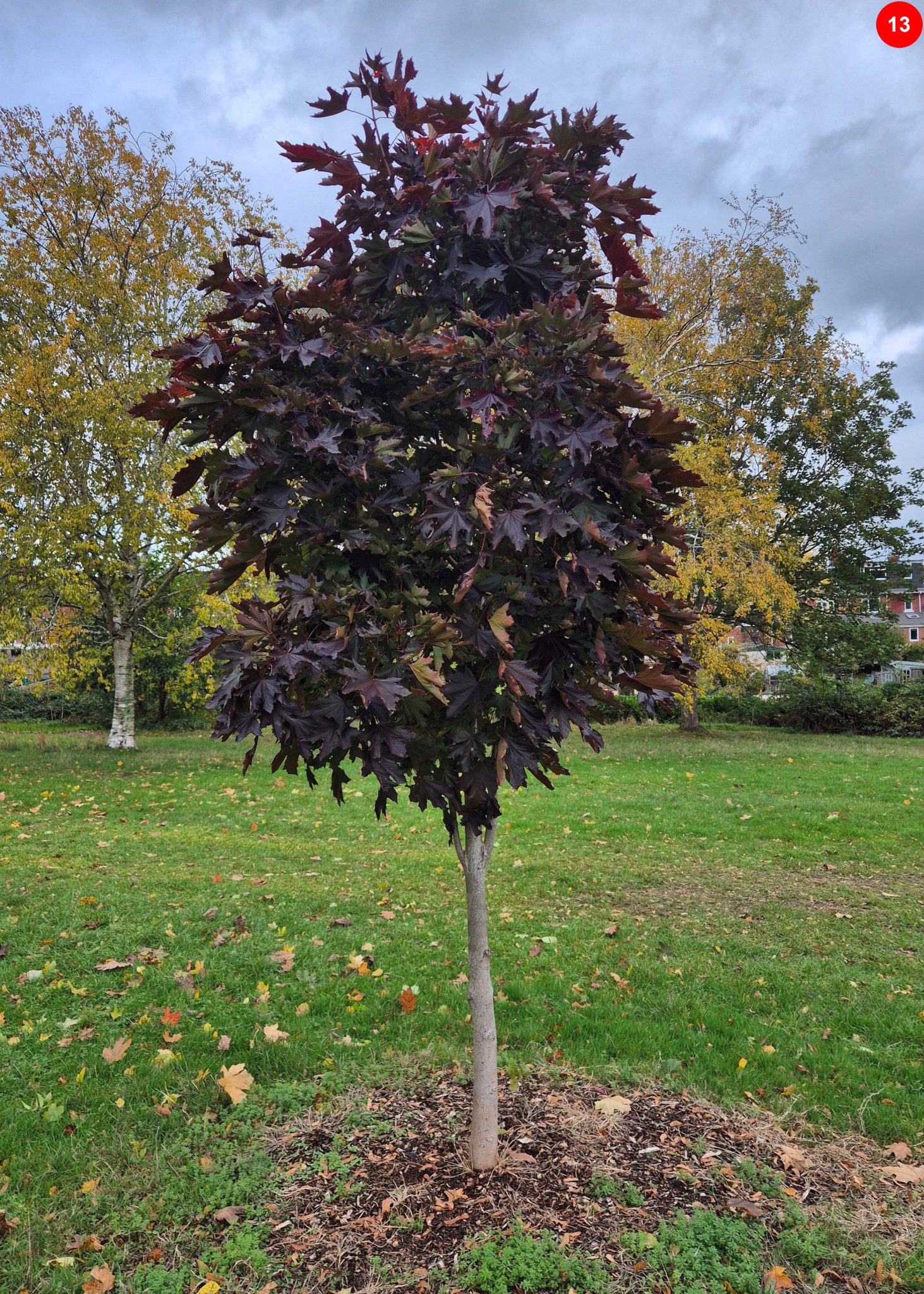
A fast-growing large tree with purple-red lobed leaves with very finely pointed tips. The attractive leaves turn orange/deep yellow in autumn.
It has bright yellow-green flowers which are very fragrant and produce large amounts of nectar attracting a variety of bees, beetles and flies. The flowers open in spring just before the leaves making them a good target for early insects.
The winged fruits are large and horizontally spread with a wide angle.
It is a cultivar of the European Maple and although named Norway Maple it didn’t originate from there. It’s thought it was imported from Norway as it was a hub for the timber and forestry trade.
They are resistant to drought and air pollution making them good for urban planting.
14 Red Oak
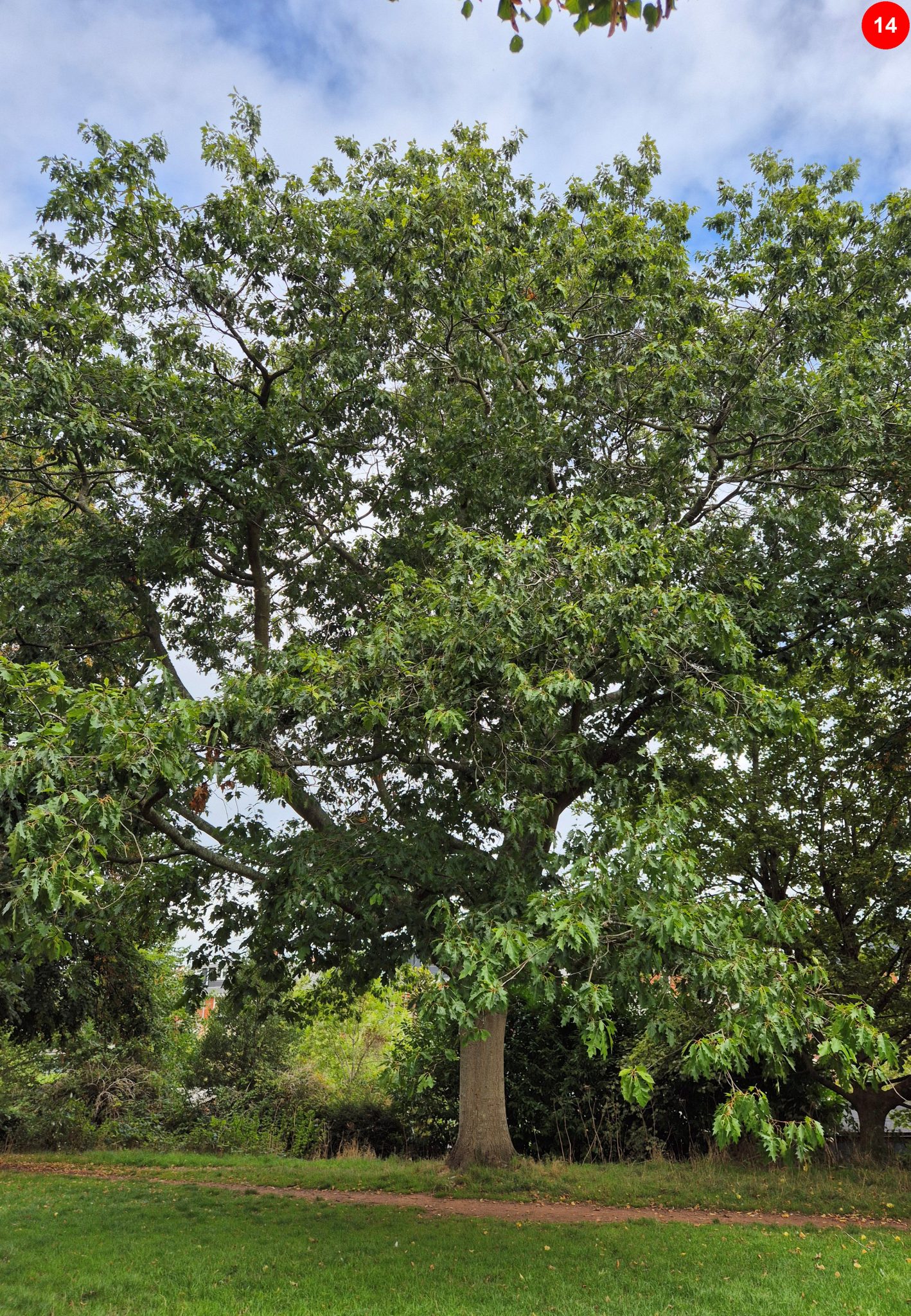
Another large deciduous tree, originating in North America, but introduced to Britain in 1724.
It’s known for its stunning rich-red / brown autumn leaves which are large, some reaching 22cm in length. The leaf lobes have several teeth with pointed whiskery ends.
The acorns, unlike our native species, take 2 years to mature and are small and only partially formed in their first year.
It is fast growing and produces timber suitable for flooring, furniture and cabinet making. Because of its open structure it absorbs stains and varnishes easily but this also makes it unsuitable for outdoor exposure as it will take up moisture..
15 Tree of Heaven
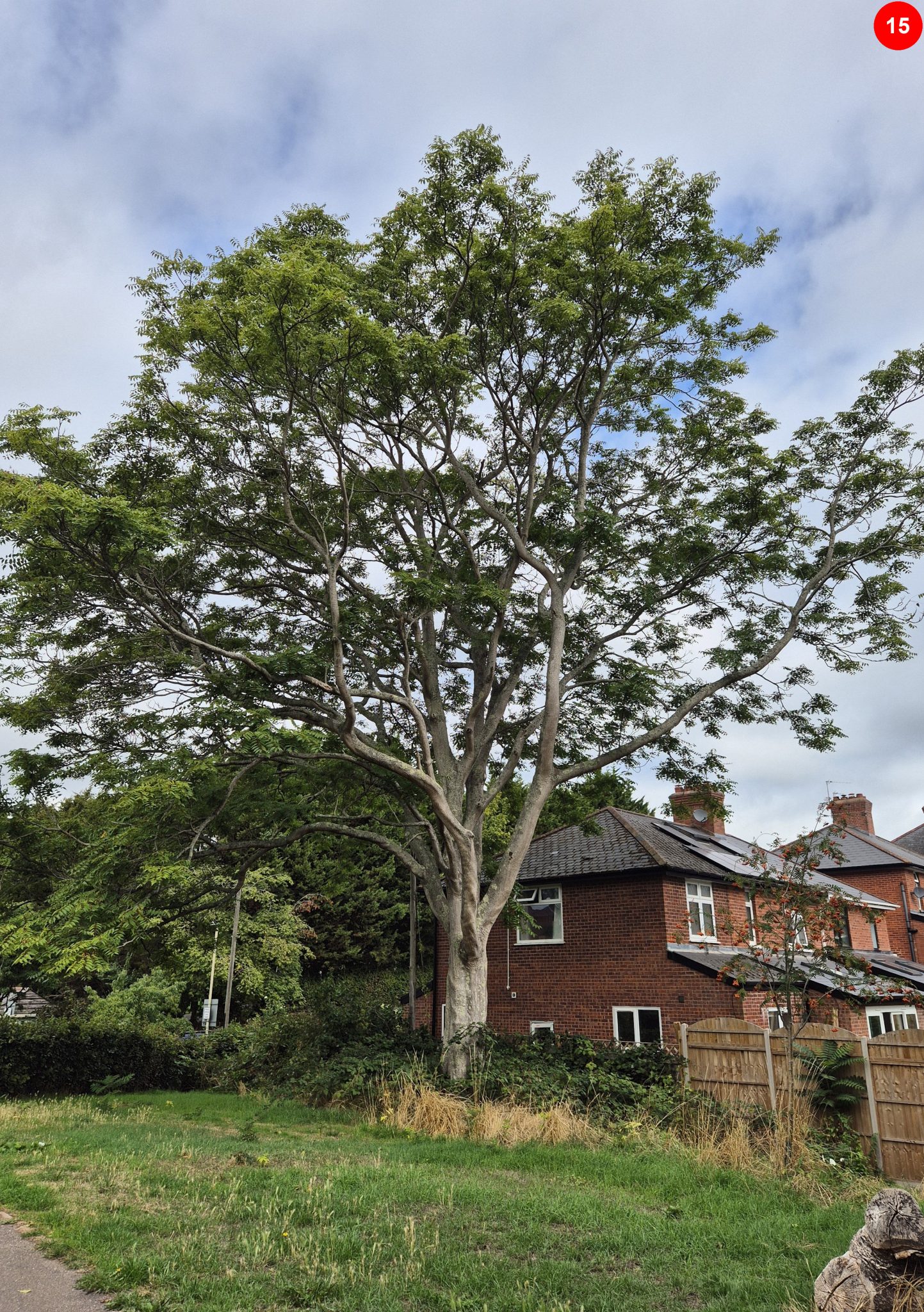
This tree originated in China and was named for its speedy growth, and seeming to be reaching for the skies. Another name for it is Tree from Hell as it has a habit of readily suckering, producing copious winged seeds, and producing a chemical that inhibits the growh of other plants nearby.
It is now classed as an invasive species and banned from sale in many countries.
16 Tulip Tree
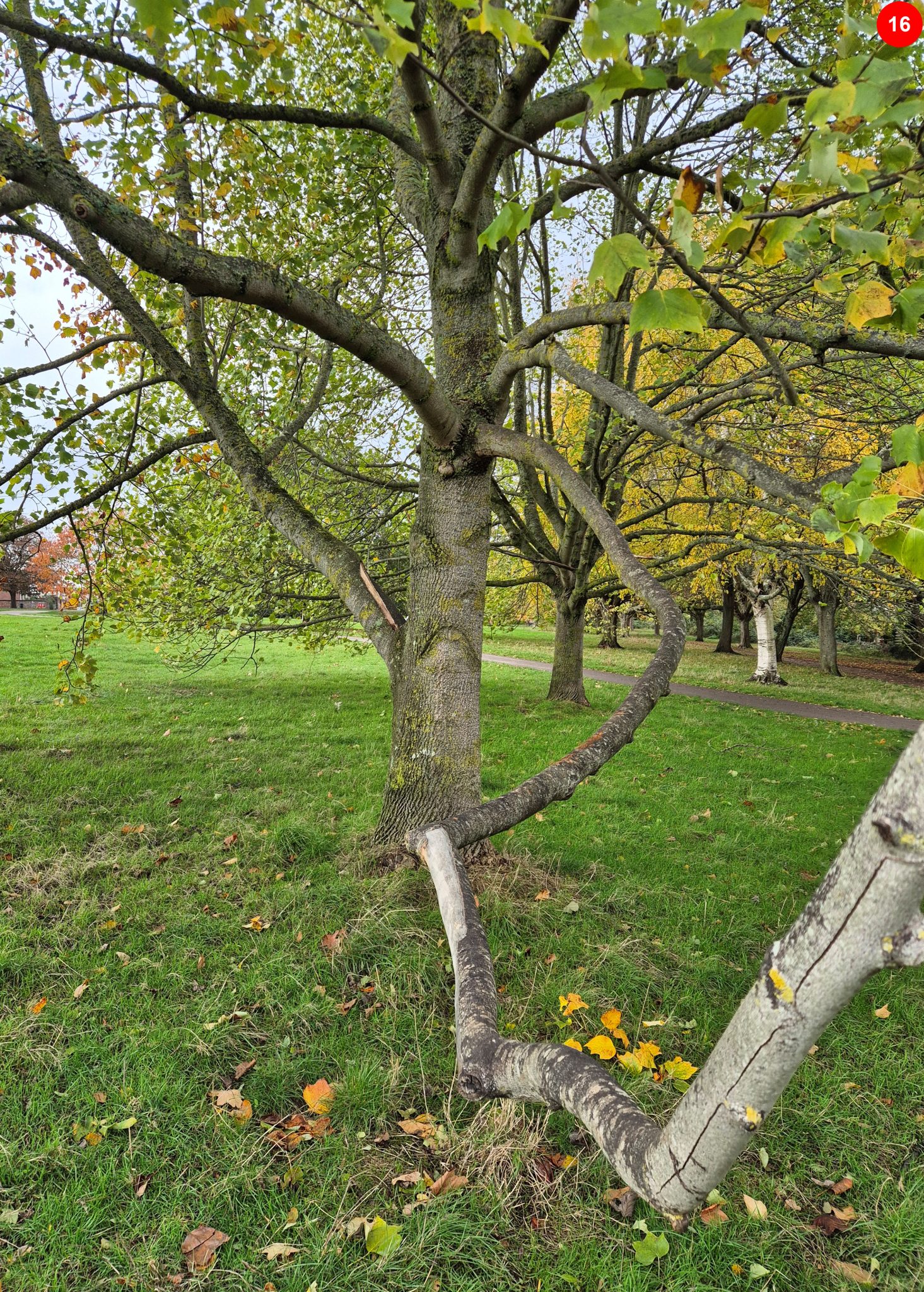
The tree is in the magnolia family and originated from N. America where it has reached heights of 60M. It was brought to this country in the 17th century and used widely in large gardens and parks due to its massive size.
The flowers, appearing in May, resemble tulips, although much larger and fragrant, and are a good source of nectar for bees. It is an ancient genus with primitive flowers adapted for pollination by beetles.
The fruit sheds seeds throughout the winter and leaves an upright spike.
Native Americans of the Appalachian Mountains used the tree to make dugout canoes as well as for building houses. Massive logs were hollowed out which could carry 20 people. Early settlers gave it the name “Canoewood”
17 Pendant Lime
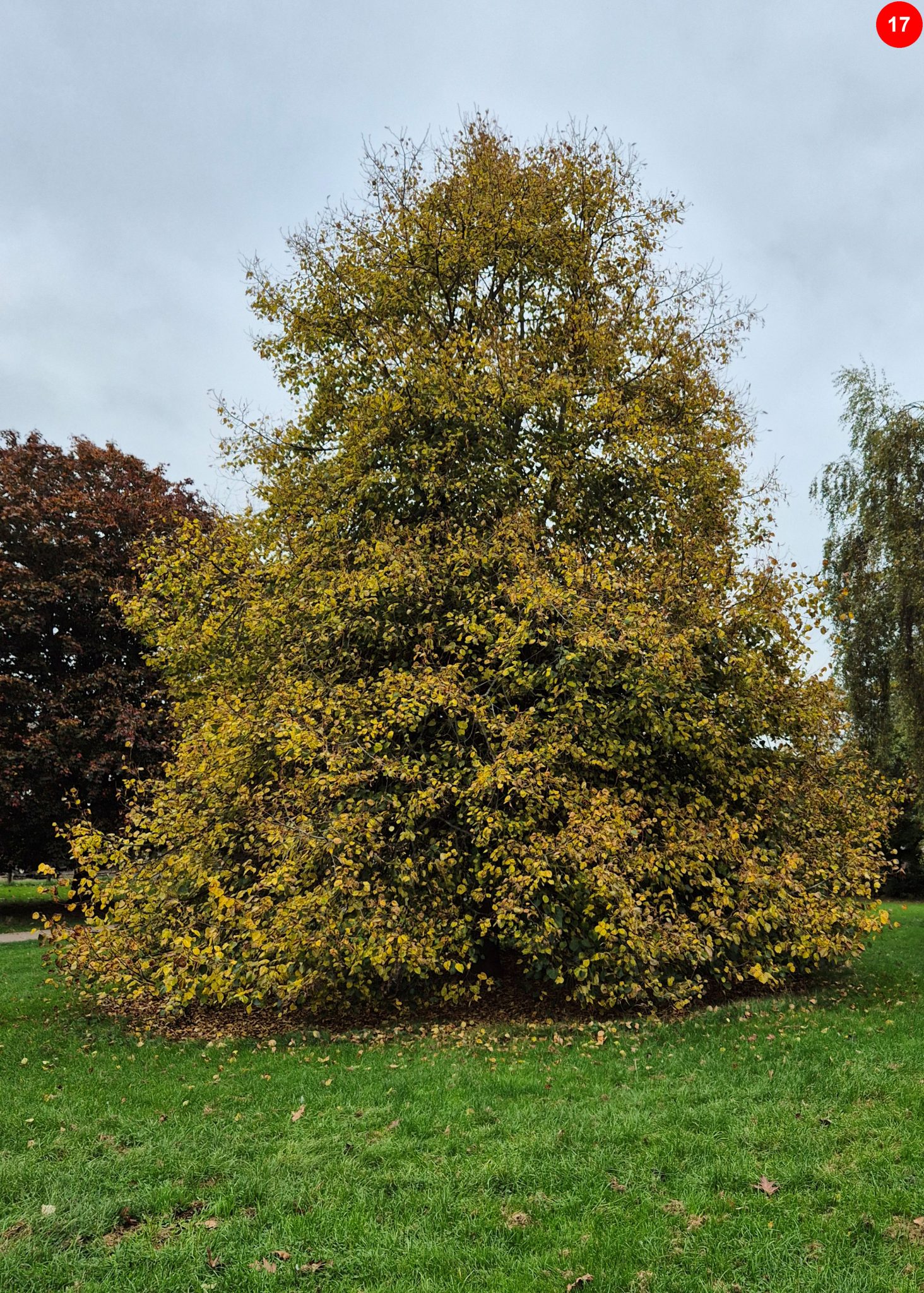
With a pyramidal shape, this tree is known as Pendant Lime from its weeping habit. Its origins are unknown but was first planted in Britain in the 1840s.
The leaves are sharply toothed and heart shaped, dark green on the top, lighter on the underside, and turn yellow in the autumn.
Clusters of drooping, very fragrant, pale yellow flowers appear in summer followed by small round fruit. These hang on a leaf-like wing which help carry the seeds in the wind when ripe.
Because the tree is usually sterile it does not reliably produce seed in cultivation so is propagated vegetatively such as grafting, as has been done on this tree.
Although it is not an orchard fruit, the flowers and young fruit have historical and culinary curiosities. The spring leaves have been used as a salad vegetable, the flowers are steeped to make a herbal tea, the sap can be collected and reduced to a sweet syrup and some foragers even roast the tiny fruits to make a chocolate tasting paste (although not verified!)
18 Manna Ash (grafted)
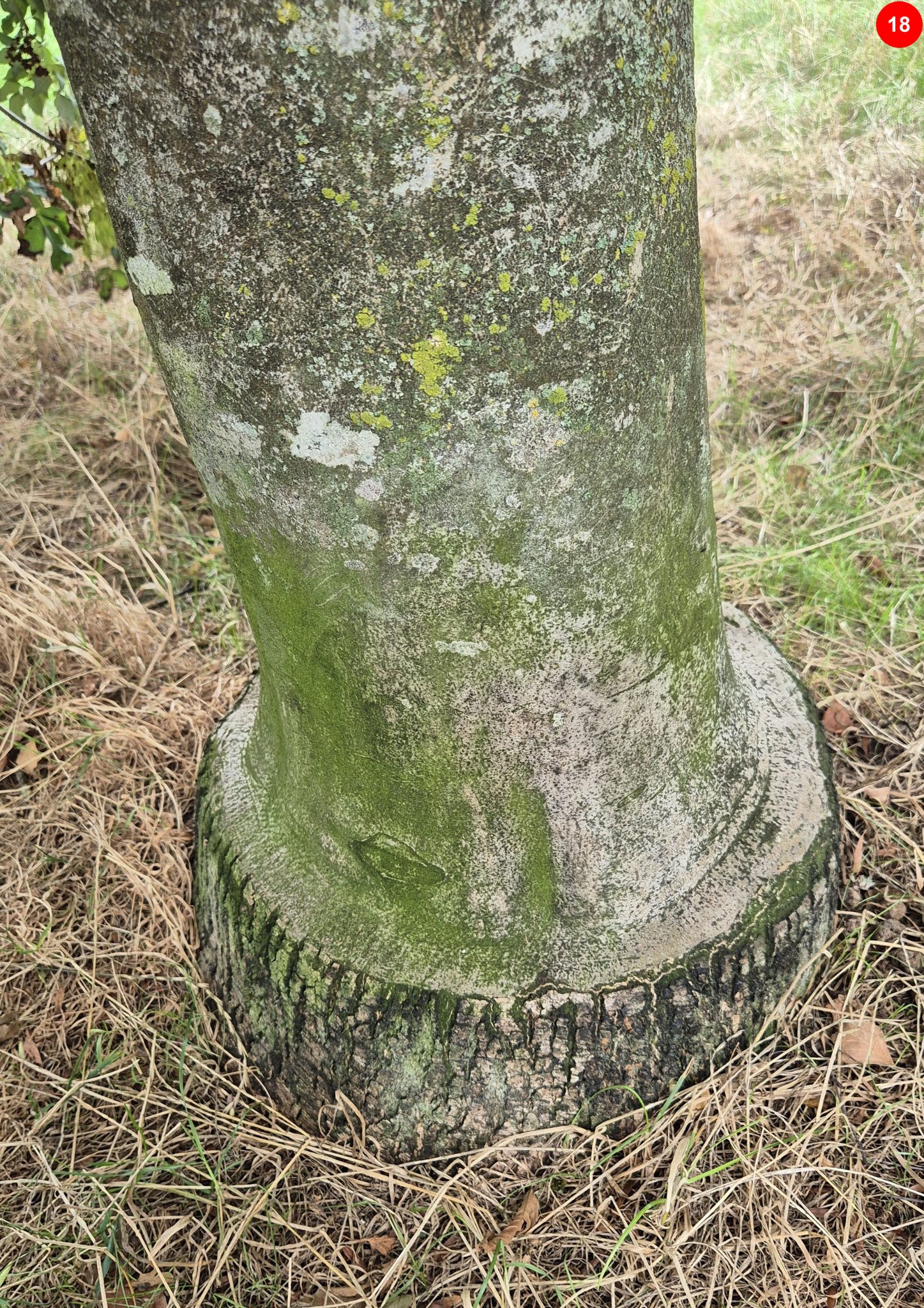
This example of the Manna Ash has been grafted onto a native ash rootstock, which will make it more tolerant of harsher climates compared to its origins in southern Europe. Grafting is also used to highlight the difference between the 2 barks and now experimentally to build resistance to ash dieback disease.
It has frothy, fragrant flowers and dainty winged fruit called samara.
19 Sweet Chestnut
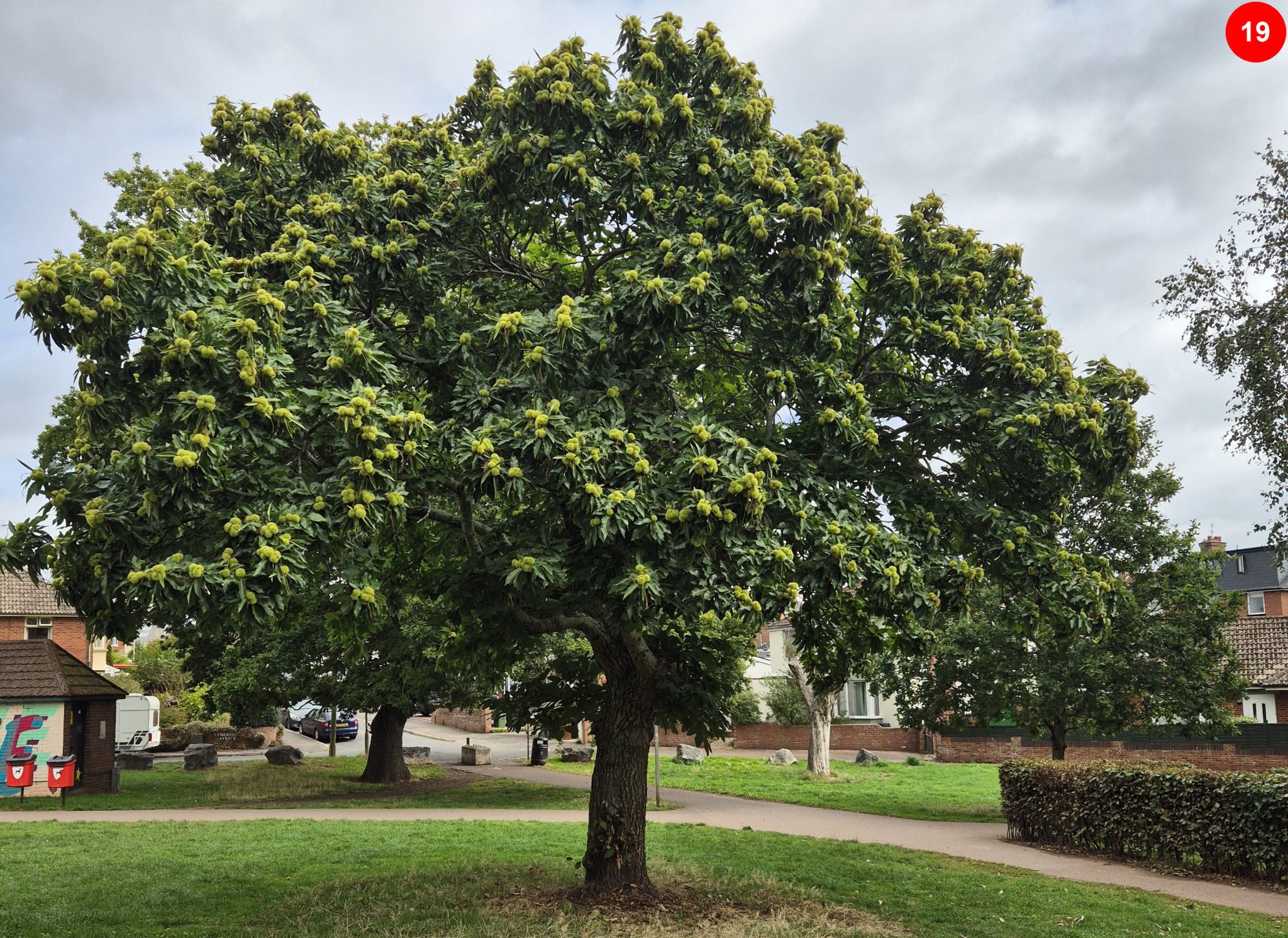
The Romans probably introduced saplings to this country from its native S. Europe. Large woodlands were planted for its edible seeds used to eat as nuts, but also in savoury and sweet dishes and ground into a non-gluten flour for baking.
It is a member of the beech family, and is not related to the Horse Chestnut as the name suggests.
The leaves are large and glossy and have sharply toothed edges. Male flowers are a vertical catkin above a rounded female appearing in summer.
The trunks of older trees grow in ridges that spiral round the trunk. This is due to prevailing wind conditions and more foliage on the south facing side, causing forces in one direction which gradually rotate the trunk. The effect of this though gives them more resilience to high winds and heavy snowfall.
The light brown wood is used for external projects such as cladding and decking, and internally for joinery and furniture. Coppice crafts like hurdle, tool handle and barrel making traditionally also utilise sweet chestnut.
20 Dawn Redwood
Until the middle of the 20th century these trees were only known from fossils dating back 150 million years to the Age of the Dinosaurs. They were then identified growing in China.
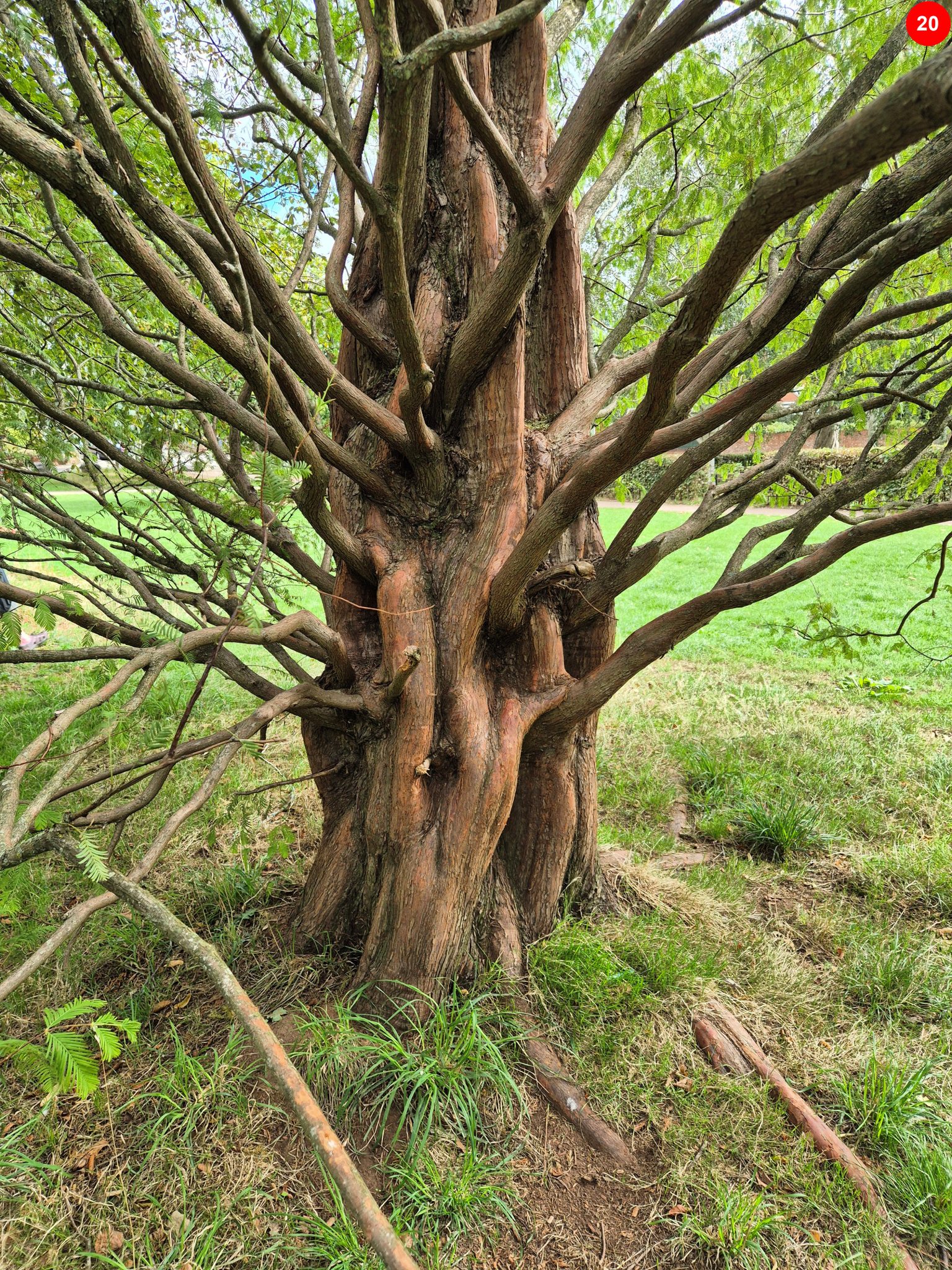
The example in Heavitree has a deeply fluted trunk and a dramatic mass of sprawling branches close to the ground.
Unusually they are deciduous conifers, meaning they produce cones but lose their leaves in the winter.
21 Oak
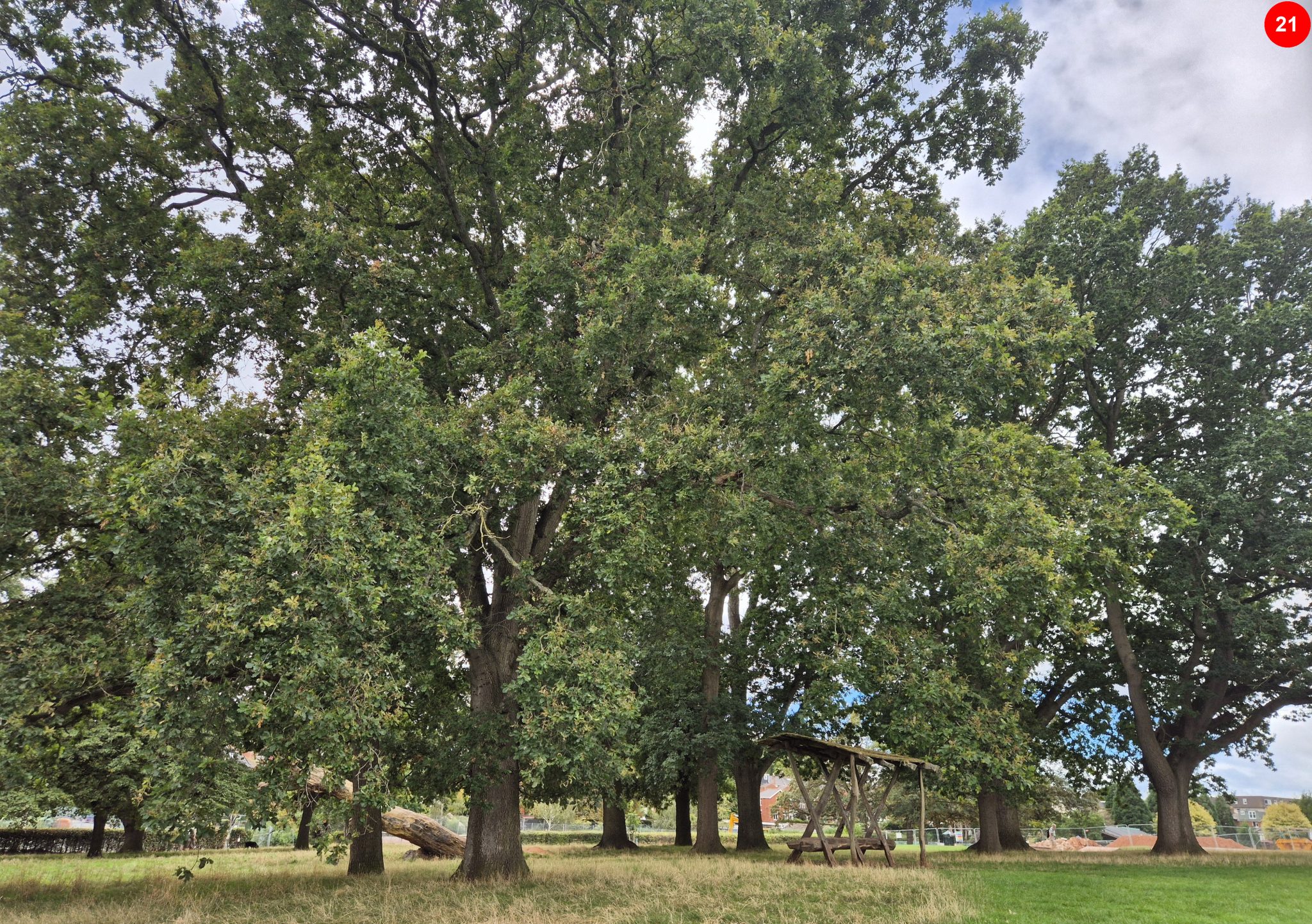
The oak is the quintessential British tree and the most common, being a symbol of strength, heritage, history and legend. Globally there are over 500 species, of which 2 are native to Britain, the English ( or Pendunculate) and the Sessile. They can grow to 60m in height and live for 1500-2000 years. In this country the oldest is King Offa’s Oak in Windsor thought to be between 1300 and 1500 years old.
Historically, pollen has been found in Austria that dates them back to 55 million years ago. They support more wildlife than almost any other tree, with records of just one tree sustaining up to 2300 species such as birds, mammals, fungi, insects and lichen.
In Spring they produce both male catkins and female flowers on the same tree which go on to produce acorns within the familiar cup.The trees are deciduous with spirally arranged leaves, often lobed or serrated.
Oaks have many uses. Their wood goes for furniture making, timber framing and traditionally for boat building, notably Nelson’s ship HMS Victory. The tannin in the bark is used for processing hides for leather, while the wood is popular for barrel making for whisky and wine. The acorns can be roasted and ground for a coffee substitute or ground into a gluten-free flour.
22 Paperbark Maple
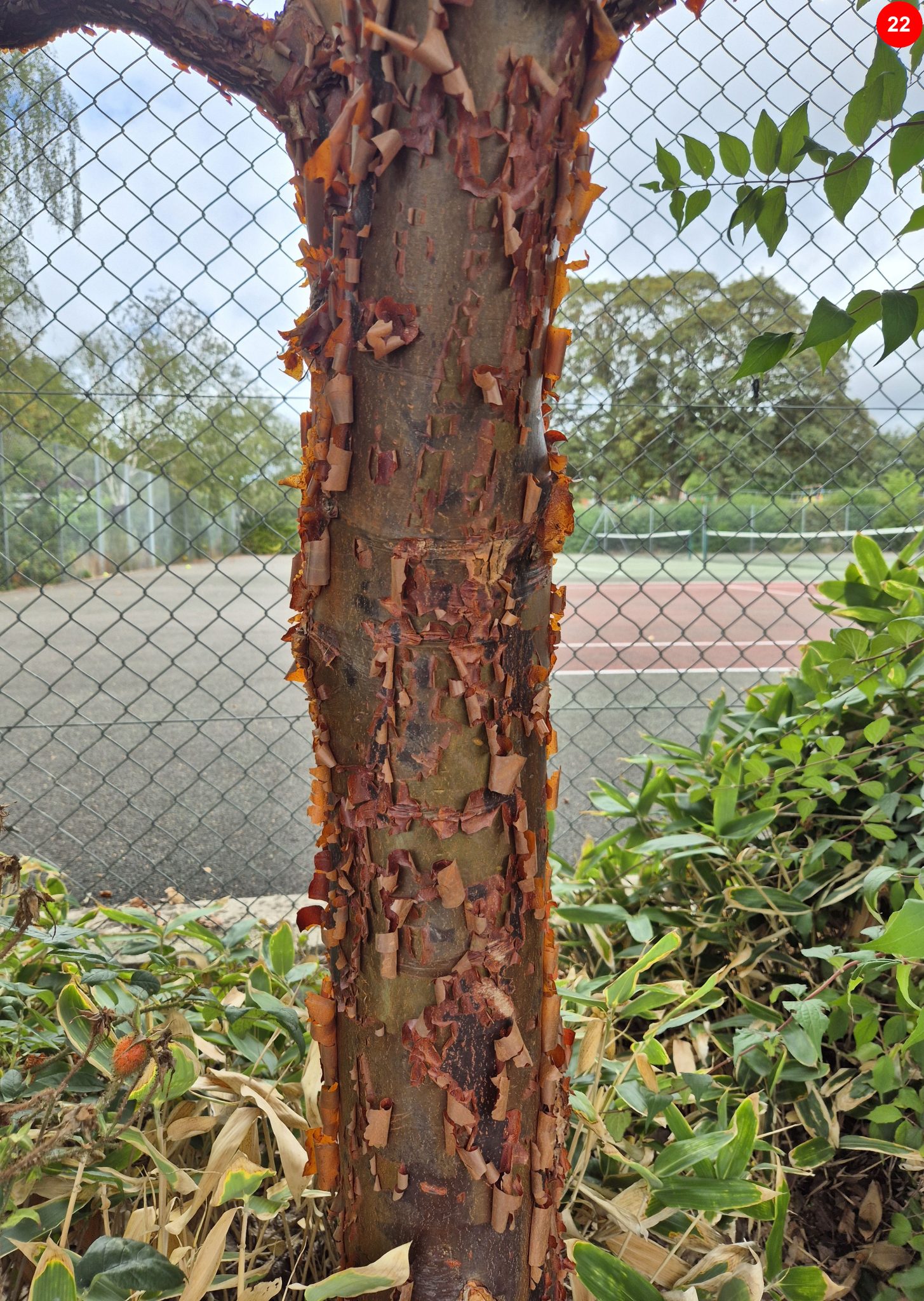
Introduced into Britain from China in 1901 for Veitch Nurseries, by Ernest “Chinese” Wilson one of the family of our renowned, local nurserymen. This is only one of about 2000 species brought to western gardens that can be attributed to him.
It is primarily grown for its decorative, exfoliating, coppery-coloured bark, which flakes and peels back to reveal the new, smooth surface.
Its main usage is horticulturally as a focal point in gardens and lawns, rather than a timber tree. It is chosen particularly for small gardens and courtyards due to its small size of up to 10M in height, and slow growth.
The flowers are small and inconspicuous, yellow in colour and appearing in spring as the new foliage emerges. These develop into the paired winged seeds, samaras, often known as “helicopters”
Leaves are trifolate with 3 leaflets turning from a dark green to shades of fiery red in autumn.
23 Black Locust
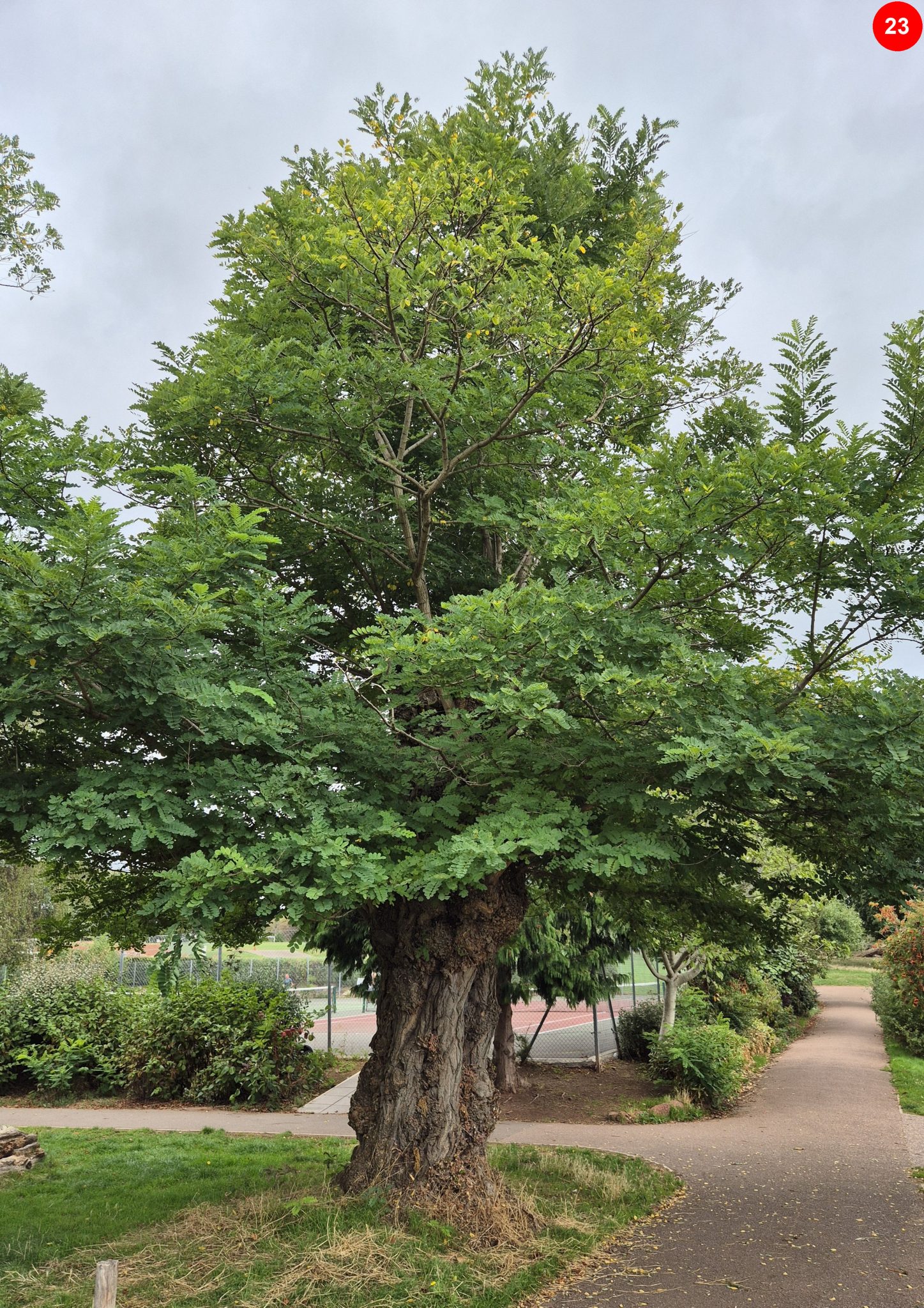
Introduced from America in 1636 it is also called false acacia, which it resembles, and is often used in urban environments. They are fast growing trees reaching up to 30m in height and tend to be invasive because of their suckering habit.
The flowers appear in late spring as hanging clusters of highly fragranced white flowers, which develop into brown pods up to 10cm long, falling in autumn, and splitting open the following spring to release the seeds.
The dark blue-green leaves are pinnate, made up of 5-19 leaflets on one stem, which often have a thorn at the base of the stem. Twigs and smaller branches sometimes carry the thorns too.
It is grown commercially as it is one of the hardest woods known and highly rot-resistant. Fence posts, furniture, flooring and firewood are the main uses of its wood, while the flowers are a good source of nectar for honey bees. Because of its ability to fix nitrogen, black locust is a good soil improver.
24 Horse Chestnut
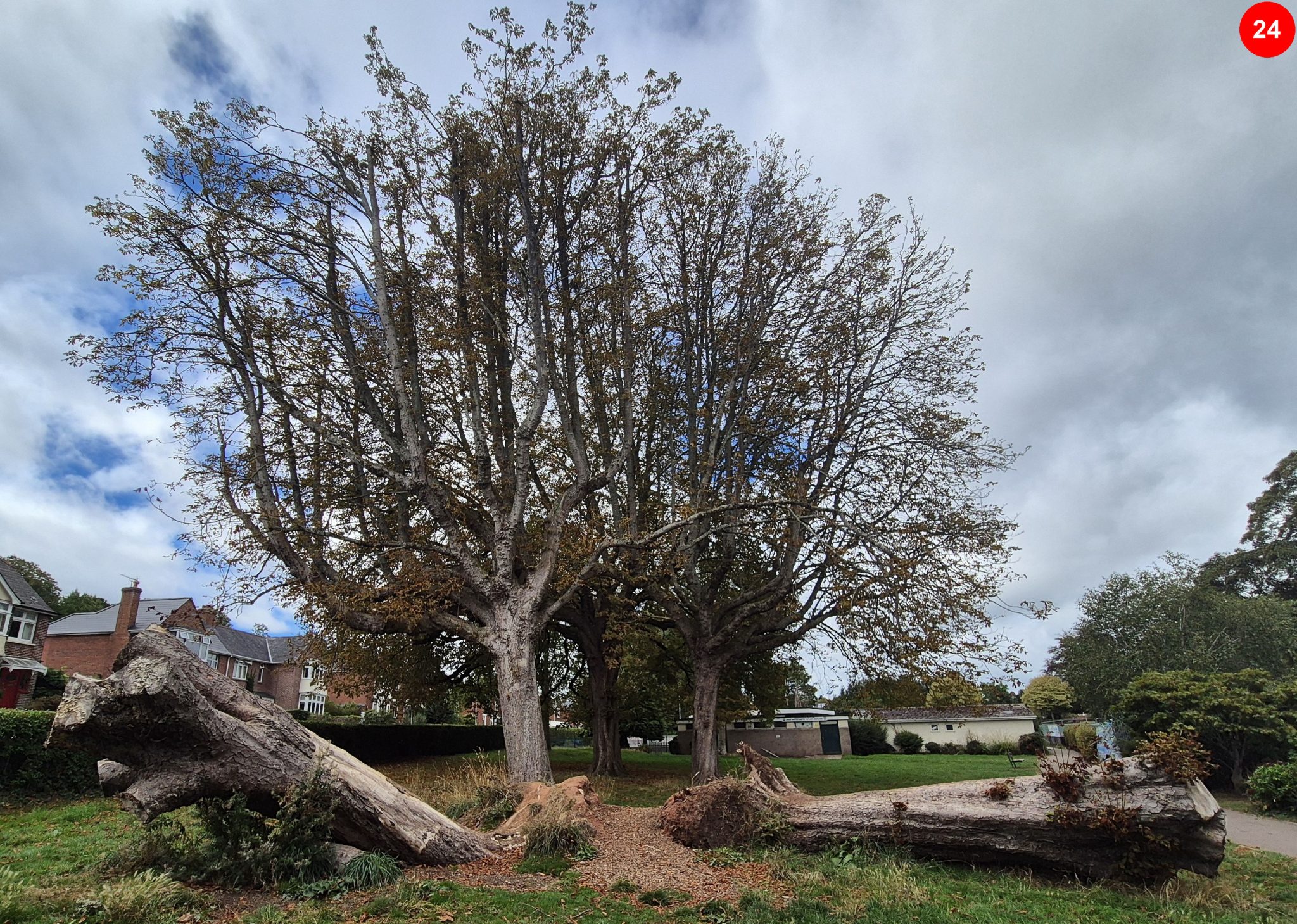
PLACEHOLDER: The horse chestnut is a large tree, growing to about 39 m (128 ft) tall with a domed crown of stout branches. On old trees, the outer branches are often pendulous with curled-up tips. The leaves are opposite and palmately compound, with 5–7 leaflets 13–30 cm (5–12 in) long, making the whole leaf up to 60 cm (24 in) across, with a 7–20 cm (3–8 in) petiole. The leaf scars, left on twigs after leaves fall, have a distinctive horseshoe shape, complete with seven “nails”.
There are 2 fallen horse chestnuts with 3 still standing.
Introduction – Heavitree Pleasure Grounds Tree Map
Exeter Civic Society with help from the Parklife Trustees and the Heavitree Local History Society have produced a tree map of the Pleasure Grounds.

The grounds contain more than 300 trees from over 60 different species. The map highlights 24 interesting trees, and a one hour walk allows you to visit them all.
You can either follow the paper map, or alternatively use an app which shows your location and the position of all 24 trees. If you click on a tree symbol more information about the tree appears. The app is available at
A listing of all the trees is available at
For more information about the Civic Societies’ Tree Activities visit
- https://exetercivicsociety.org.uk/concerns/tree-preservation-taskforce/ or
- https://tinyurl.com/hwu2mh64
Ordnance Survey Map 1887
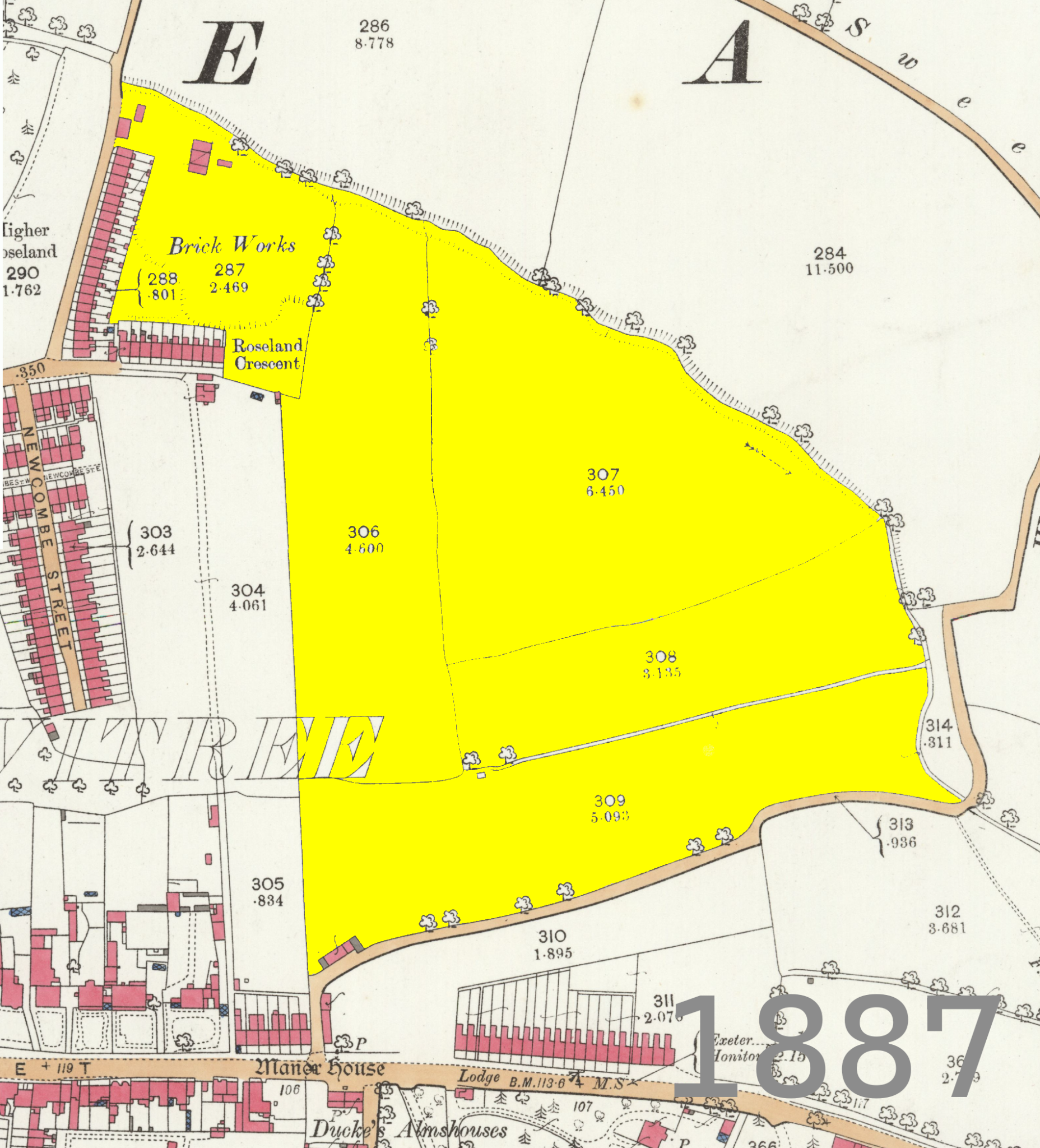
The 50 inch to the mile Ordnance Survey map of Heavitree from around 1887.
The area currently occupied by the Pleasure Grounds was five fields. Part of the most north westerly field was occupied by a brick works.
The Heavitree Urban District Council subsequently bought the other four fields for £3,100 to provide a play area for the area’s youth, which had become “rowdy” in the streets during the evenings.
Ordnance Survey Map 1937
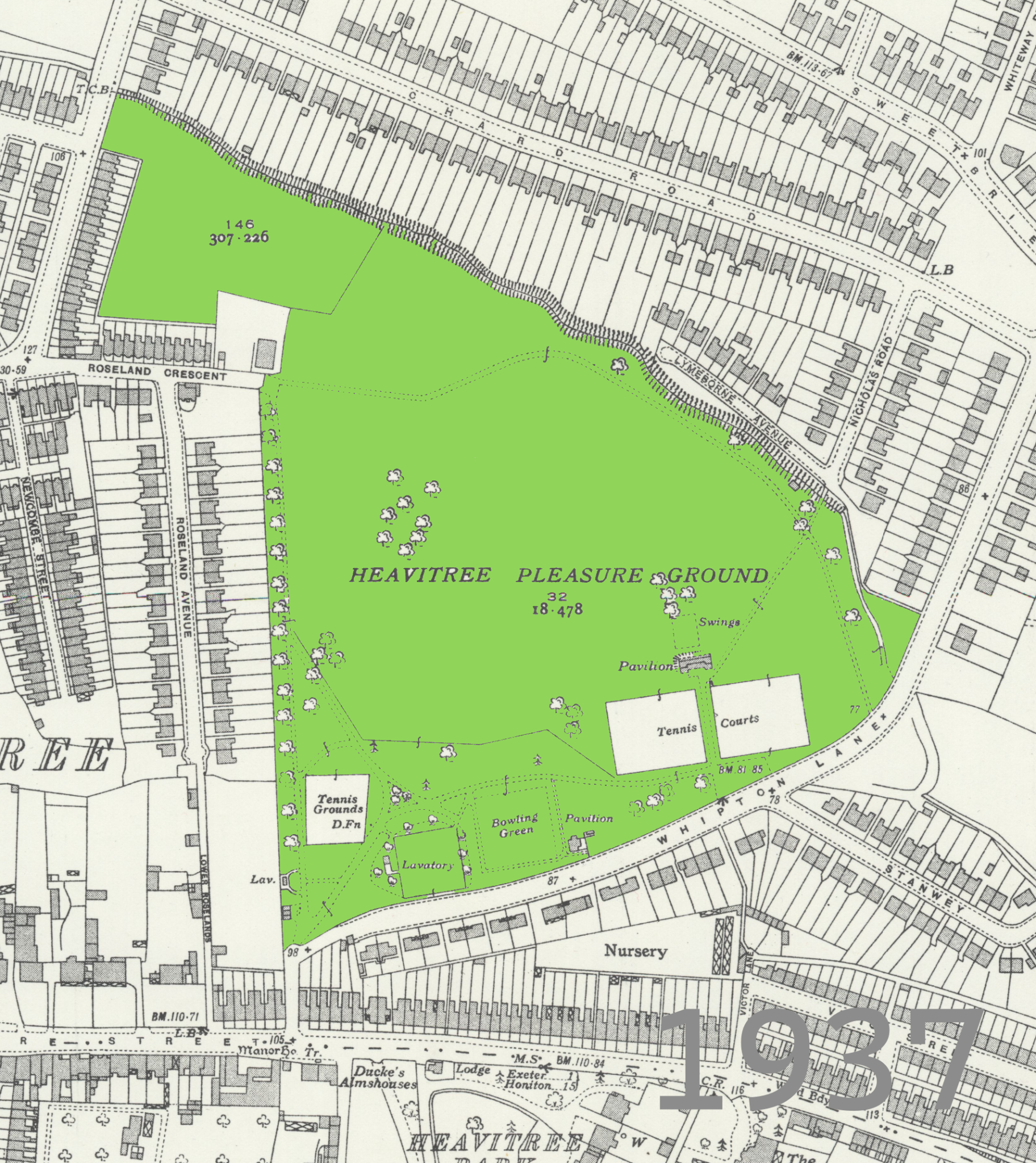
The 50 inch to the mile Ordnance Survey map of Heavitree from around 1937.
In 1905 the grounds were designed and landscaped by F. W. Meyer of the Veitch nursery, a renowned local horticultural firm.
The children’s playground was officially opened on May 1, 1906, and a bowling green and tennis courts were added a year later in 1907.
In 1937 there were considerably fewer trees than at present, although there was a line of 16 Horse Chestnuts adjacent to Roseland Avenue. These have all now been replaced. It’s also noticeable that the Giant Sequoias hadn’t been planted at this time.
By 1939, the park had been expanded to its current size of 19 acres and included hard tennis courts and a children’s nursery ground.